Archive for the 'Justice & Mercy' Category


25
Apr
09

G-6.0106b Amendment 08B


UNOFFICIALLY, The “NOs” have won with Northern Plains Presbytery being the 87th negative vote. While the voting of the remainder of the presbyteries may represent some interest, one more time the majority of PC(USA) members/churches have shown their blind adherence to tradition even in the face of evidence to the contrary, lack of informed theology and dearth of compassion. It is another sad day in a line of sad days. May God forgive us.

ALBANY PRESBYTERY IS ONE OF  SIXTY-FIVE SIXTY-EIGHT TO DATE (INCLUDING TWENTY-FIVE TWENTY-EIGHT THAT HAVE HISTORICALLY VOTED AGAINST)  VOTING FOR THE AMENDMENT.   

This will undoubtedly only be of interest to other Presbyterians – or maybe not.
 
 A full tally can be viewed here, courtesy of Presbyweb.
While not the nail in the coffin, so to speak, San Francisco Presbytery provided the biggest shock and disappointment when it became the first to flip from support of LGBT to opposition. This is less likely to be a sign of growing opposition and more likely to be a sign of complacency, laziness and arrogance on the part of usual supporters. 58 fewer members of the presbytery voted this time when compared to the last attempt at an amendment, presumably because many didn’t feel the need to show up and vote. How commendable!

Continue reading ‘G-6.0106b Amendment 08B’

24
Apr
09

Thanks, Emproph

cartoon-1

24
Apr
09

The Parable of the Sower – Matt 13:1-23

SOWING OUR SEEDS

“Listen!”  That’s a word meant to prick up the ears of the hearer; a word meant to get people to pay attention. And where do we hear, “Listen!”, but in Jesus’ first parable in the Gospel of Matthew. (You can read the passage here.)

The parables, for me, represent in blazing color the fact that scripture is not to be taken simply at face value. It is meant to be worked through, to be wrestled with, to be mined for meaning and relevance. The parables not only defy an easy understanding, but they are designed to be thought about and reflected upon. How do we know that? From the word itself. The Greek is paraboley, and means to compare – literally “to put things beside each other”.

With this parable, we have a little easier time than with many. While the parables, in general, use concepts that would have been very meaningful to people of that time, but not so clear to us today, this one makes use of symbols that are just about universal. We hear about seed, paths, rocky soil, fertile ground – in short, we hear about agriculture. That should make it easy to understand – right? Unfortunately, it’s not that easy. Continue reading ‘The Parable of the Sower – Matt 13:1-23’

22
Apr
09

Calvin’s Spirituality – Not an Oxymoron

Within the first few pages of Elsie Anne McKee’s John Calvin – Writings on Pastoral Piety, I was stricken with disbelief. Incredibly, McKee used ‘piety’ and ‘spirituality’ interchangeably.[1]  “Now I know piety and it’s not spirituality,” I said in no uncertain terms as I looked it up in my dictionary and read “having or exhibiting religious reverence; earnestly compliant in the observance of religion; devout.”[2]  Hmmm. I then thumbed to spirituality and found “the quality or state of being spiritual; pious; heavenly-mindedness.”[3]  It appeared my negative understanding of piety as rigid, dogmatic and judgmental belief was based far too much on my early experiences with the somewhat puritanical Christian Reformed Church in Australia. Continue reading ‘Calvin’s Spirituality – Not an Oxymoron’

21
Apr
09

Integrity over Doctrine – A Brief Look at Erasmus

During the Renaissance, an age when tensions and aggressions were rising in the church, many were seeking to cling to their positions of power, prestige and wealth within the ecclesiastic structures. Reformation was brewing, both inside the Roman Catholic Church and outside, and a new age of appreciation for classicism and scholarship was developing. Critical alliances were being created and restructured between various feuding parties and the religious rift called the Protestant Reformation was materializing. Orthodox doctrine and traditional praxis were the most significant religious dimensions necessitating debates, with ecclesiology and sacraments being key elements in the discussions. At risk were the equally important treasures of eternal souls and temporal assets. Within this fray stood Erasmus, a great religious mind, exegetical thinker and biblical scholar, being courted by both sides of the battle but aligning himself fully with neither. Continue reading ‘Integrity over Doctrine – A Brief Look at Erasmus’

28
Mar
09

Anatomy of Conflict

Any group of people, whether it is a club, company, church, synagogue, association or other entity, is a body or system. While very few of the people involved may relish conflict, it is a critical component of a healthy system. Absent opposing pressures, the system will cease to function. The body serves as the best example, as almost all muscles are formed in pairs. Movement of any kind, even as simple as changing the gaze from a near point to a far point, is accomplished by the opposing mechanical processes of muscles. A healthy system recognizes the inherent value of conflict, mitigates the normal human responses of “fight or flight”, and uses the opposing pressures to create healthy and viable action. That being said, most human systems or organizations have little to no capacity for utilizing conflict constructively. Continue reading ‘Anatomy of Conflict’

25
Mar
09

The Nature of Prayer

 What do I consider to be the nature of prayer? I’ve been asked many questions about prayer and people’s prayer lives, but this one caused me to really think about my answer. As it turns out, I’ve written twenty page essays on less involved topics, but will do my best to address the high spots of my thoughts.

Prayer, for me at least, fits into three categories: personal, communal and liturgical. Admittedly the last two are not neatly separated, but in my definition communal prayer is that which occurs between two or more people outside of a formal service or liturgy.

Personal prayer varies considerably but generally fits under an umbrella of “conversation with God”. Continue reading ‘The Nature of Prayer’

23
Mar
09

Religions Put Emphasis on Least Theological Issues

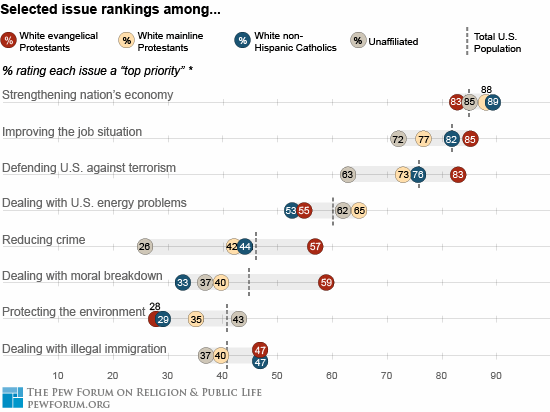
Theologically speaking, God can be found in all situations. In even the most heinous of events, we can trust God to be at least suffering with those who suffer, mourning with those who mourn and crying with those who cry. So even in this trying economic time, we can envision God’s concern for those who are worst hit by our unfolding system of commerce – the worst hit, of course, being the poorest of the poor and not particularly those whose fortune may have been trimmed by a few billion. Given this, I find interesting the results of a Pew Forum survey of religious people in which they were asked where President Obama and the legislature should concentrate their efforts. Additionally interesting, although I have yet to find an explanation, is the fact that the categories include only white religious people. We are left to surmise the purpose of that decision.

pew623

Continue reading ‘Religions Put Emphasis on Least Theological Issues’

20
Mar
09

Post-Exilic Community in Haggai & Zechariah 1-8

While there seems to be little disagreement over the dating of the prophesies of Haggai and Zechariah[1], the same cannot be said about conditions of the society to which they were delivered. To a large extent, the differences stem not so much from the content of these Biblical books as from varying ideas about the nature of the Babylonian exile of the Judeans. Knowledge of the number and societal standing of the exiles would, of course, have great bearing on the current understanding of both the returning exilic population and those remaining in Judah during the course of the seventy year dispersion. The details relating to the Judean society that can be gleaned from the pages of these prophetic books must be examined in light of the range of ideas that prevail about the previous period. Continue reading ‘Post-Exilic Community in Haggai & Zechariah 1-8’

14
Mar
09

Youth See Church as Judgmental

A majority of young people in the U.S. today describe Christianity, and the Christian church generally, as judgmental and hypocritical. Many have abandoned the name “Christian” altogether because of the “baggage” that accompanies the name. A new book released by The Barna Group, which does research of and for evangelical churches, found that church attitudes about many groups of people are driving people ages 16-29 to stay away from the church.

Even churches in the “liberal tradition”-otherwise called mainline denominations-have been heatedly embroiled in debate over the exclusion of a certain segments of the population. “The Christian community’s ability to take the high road and help to deal with some of the challenges that this perception represents may be the … defining response of the Christian church in the next decade,” said David Kinnaman, Barna Group president and author of the book, UnChristian: What a New Generation Really Thinks About Christianity. Continue reading ‘Youth See Church as Judgmental’

12
Mar
09

Book Review – Between Vengeance and Forgiveness

How do nations or societies respond after periods of mass violence, indescribable episodes of systematic torture, rape and slaughter of minority or marginalized populations, or even ethnic cleansing and genocide?  Historically, of course, the most common response of populations freed from such oppression has been retaliation in at least equal measure, if not more profoundly violent and obscene in character. Despite the world, in the twentieth century, experiencing atrocities of more magnitude and frequency than ever before, Martha Minow somewhat optimistically details several societal responses aimed at seeking collective healing and reconciliation. After discussing the poles of vengeance and forgiveness, Minow expounds on the strengths and limitations of legal remedies, truth commissions and efforts at reparation, before finishing with other possible efforts for reconciliation. Continue reading ‘Book Review – Between Vengeance and Forgiveness’

12
Mar
09

Running Someone Through the Wringer … several times

Paul Capetz is my one sorrow from the two years I spent at United Theological School in the Twin Cities, my alma mater. I never took a class from Paul, although I benefitted from his faith, wisdom and intellect in other ways. I have no doubt that Paul would have joined the ranks of Chris Smith, Jann Weaver, Eleazar Fernandez and Sharon Tan as exceptional teachers I have experienced first hand. Don’t get me wrong, NONE of the professors at United from whom I took classes were less than great, but these just stood out as truly inspiring. To my great disappointment, I will never know Paul firsthand as a teacher.

I could also never know, firsthand at least, the stress and agony that Paul must be feeling at the hands of an unwieldy ecclesiastical judicial process that is far better equipped at passing a “hot potato” than actually making informed, judicious decisions. Rather than fill some with awe at the intricate workings of judicial machine, which is how I have read some comments, it should fill all Presbyterians with shame. As always, the hand-wringing and juggling of important matters has a human face, and I can only imagine the agony that Paul must feel at times. Continue reading ‘Running Someone Through the Wringer … several times’

03
Mar
09

What Must Our Children Think

I’ll think about the following the next time I hear someone say something about the “younger generation.”

There are some interesting statistics – nay, absolutely awful ones – from a CNN article this morning. According to the Pew Center on the States, there were 7.3 million adults incarcerated in this country during 2007. A synopsis of the statistical findings should raise a lot of questions:

That is over 3 out of every 100 people in the country.

People of color were disproportionately more represented than whites – over 9 per 100 of black adults and more than 5 per 100 of Hispanic or Latino adults.

Maybe that doesn’t sound too bad to you, Continue reading ‘What Must Our Children Think’

27
Feb
09

Is Hate a Mental Disorder?

We live in interesting times. Since the election of Barack Obama, hate groups have begun growing. Since the economy has tubed, hate groups have begun growing. Hate, it seems, flourishes whenever major change occurs or disaster strikes. According to a CNN article, “Growing Hate Groups Blame Obama, Economy“, hate proponents seem to think they have very rational grounds for their attitudes and actions. As a culture we seem to regard hate with varying degrees of disdain or apathy. Blatant racism is largely disdained, while blatant sexism is discouraged and heterosexism seemingly encouraged. All, however, are based on irrational fears and anti-social behavior. In what way are any to be considered normal responses? Continue reading ‘Is Hate a Mental Disorder?’

16
Feb
09

The Baby in the Bath Water

In colonial America, as in other places where water was fetched and heated only with great effort, ablutions were a family process. One by one, beginning with the father, then the mother and continuing through the youngest child, all would bath in the same tub of water. Both parents, as well all the oldest kids, worked the fields and tended the livestock. Of course, children also played outside. Saturday, in order to be clean for Sunday church service, was the proverbial bath night.  The old German proverb, “Don’t throw the baby out with the bathwater” had a very real meaning for early American settlers. Admittedly, even though the water was so tepid and dirty by the time the youngest of perhaps a dozen or more children were finished bathing that it would have been easy, it would have been ridiculously rare, if it ever happened at all, to loose a child in the muck. Rather than literal, the saying came to represent a frontier dweller’s value for resources similar to that expressed in the adage, “one person’s trash is another person’s treasure.” Continue reading ‘The Baby in the Bath Water’


... or, preaching from both ends

WELL, HELLO! YOU’RE HERE.

That's too bad - I'm so sorry. Oh, well, just try to make the best of it. What you'll find here is a variety of essays and ramblings to do with things theological, social, whimsical and, sometimes, all three. I don't write to get famous - trust me, I've been told how futile that would be - but to express myself. I love to communicate and browbeat - ummm, I mean dialogue - about the things I find intriguing. Since you're here, and the door's locked, why don't you stay a while. There's a page bar under the header with links to information about us - I mean me. Don't forget to tell me what you think - in a nice way, I mean.

Readers since Jan 2009

  • 146,386 posts read

Archives