Over the last few years, one of my favorite preaching topics has been the abandonment of self-interest, selfish ambition and conceit that is extolled in Philippians chapter 2. The call to humility contained within that passage culminates with “work out your own salvation with fear and trembling,” (2:12) which, I remind the congregation I am addressing, is difficult to do with someone else’s theology tucked under your arm. To be free of your own conceit requires being free of theological tenets that establish authoritarian norms of belief. It is to acknowledge that certainty is the opposite of faith, not doubt. Continue reading ‘Wrestling with Personal Theology’
Archive Page 9
30
Mar
09
A Parable based on Gen 19:1-15
Two gay men and two lesbian women came to Sodom in the evening as Rev Lot was communing with some local folk downtown. When Rev Lot saw them, she rose to meet them and extended her hands, because she saw, in the faces of these people, the image of God – the very tired and rejected faces of Christ. Continue reading ‘A Parable based on Gen 19:1-15’
29
Mar
09
Covenant Stressed
COVENANT STRESSED – Why Ministers and Laity Leave Church
Much has been written, over the last several years especially, about the level of stress experienced by clergy. Stressors are cited as reasons for clergy infidelity, sexual misconduct, power abuse and the number of professionals leaving ministry. Conflict, usually at the local church level, is the most common type of stressor cited. Quite understandably, much of the work done in this area of study uses the techniques and language of sociology and psychology. Covenant, however, is not a concept strictly, or even commonly, associated with either of these disciplines, while it is a central tenet of the bulk of Christian pastoral effort. Covenant is a mutual relationship. Church members, clergy and officers are equally important in the relationships of the church, and can fall prey to exactly the same kinds of stresses. In my estimation, studying the role of covenants, or rather broken covenants, might yield far more meaningful results for understanding church stress generally, and the reason so many leave the church specifically. Continue reading ‘Covenant Stressed’
29
Mar
09
Road Trip to Love
When driving on a long trip, the route I take depends on whether I am driving for pleasure or expediency. If my schedule is tight, needing to travel a long distance in the shortest time possible, I prefer to travel on the interstate. I want to get where I’m going quickly; I print off a map, set the cruise control, zoom past the sights and stop only when absolutely necessary. But when time is not a big factor, and the sun is shining, my priorities change. Then, I avoid the interstates whenever possible – they’re boring. I drive on state routes and even occasionally back roads, enjoy the scenery and occasionally stop in interesting towns even if I don’t need to gas up. I always have several options for getting from one place to another.
When Jenna is with me, a third way to travel sometimes develops. You see, Jenna is kind of averse to going too far without stopping to see something interesting, or to enjoy a moment of peace. Generally, she reminds me that I also need this kind of break in the journey – generally. Continue reading ‘Road Trip to Love’
28
Mar
09
God’s Economy
Having accepted the challenge to discuss economic theology with a Presbyterian session of a large metropolitan church, and having overheard in conversation the “ideal” minister being described as a “CEO” type, I began with a simple exercise – one I had presented several times before to different audiences. The exercise takes advantage of the preponderance of business language and processes being used by sessions and boards of religious institutions.
28
Mar
09
Anatomy of Conflict
Any group of people, whether it is a club, company, church, synagogue, association or other entity, is a body or system. While very few of the people involved may relish conflict, it is a critical component of a healthy system. Absent opposing pressures, the system will cease to function. The body serves as the best example, as almost all muscles are formed in pairs. Movement of any kind, even as simple as changing the gaze from a near point to a far point, is accomplished by the opposing mechanical processes of muscles. A healthy system recognizes the inherent value of conflict, mitigates the normal human responses of “fight or flight”, and uses the opposing pressures to create healthy and viable action. That being said, most human systems or organizations have little to no capacity for utilizing conflict constructively. Continue reading ‘Anatomy of Conflict’
25
Mar
09
The Nature of Prayer
What do I consider to be the nature of prayer? I’ve been asked many questions about prayer and people’s prayer lives, but this one caused me to really think about my answer. As it turns out, I’ve written twenty page essays on less involved topics, but will do my best to address the high spots of my thoughts.
Prayer, for me at least, fits into three categories: personal, communal and liturgical. Admittedly the last two are not neatly separated, but in my definition communal prayer is that which occurs between two or more people outside of a formal service or liturgy.
Personal prayer varies considerably but generally fits under an umbrella of “conversation with God”. Continue reading ‘The Nature of Prayer’
24
Mar
09
The Fullness of Communion
For those who are unfamiliar with the significance of the Lord’s Supper or Communion, I’d like to offer my thoughts. Since Communion is a sacrament observed by the Church, it is a little risky to assume what someone does or doesn’t know about Church, Church Mission and Membership. So, before moving into the discussion of the Lord’s Supper, I’ll spend a little time unpacking the luggage with which it travels. This is necessary because communion doesn’t exist as a separate ritual, but as an integral part of the life of the Body of Christ. It is also necessary because many ask for a quick explanation of the meaning of communion which, for the life of the church, is like asking for a short answer to the meaning of life. Without communion, church may largely lack meaning. Much of this is sourced directly, or interpreted, from the PC(USA) Book of Order. Continue reading ‘The Fullness of Communion’
Theologically speaking, God can be found in all situations. In even the most heinous of events, we can trust God to be at least suffering with those who suffer, mourning with those who mourn and crying with those who cry. So even in this trying economic time, we can envision God’s concern for those who are worst hit by our unfolding system of commerce – the worst hit, of course, being the poorest of the poor and not particularly those whose fortune may have been trimmed by a few billion. Given this, I find interesting the results of a Pew Forum survey of religious people in which they were asked where President Obama and the legislature should concentrate their efforts. Additionally interesting, although I have yet to find an explanation, is the fact that the categories include only white religious people. We are left to surmise the purpose of that decision.
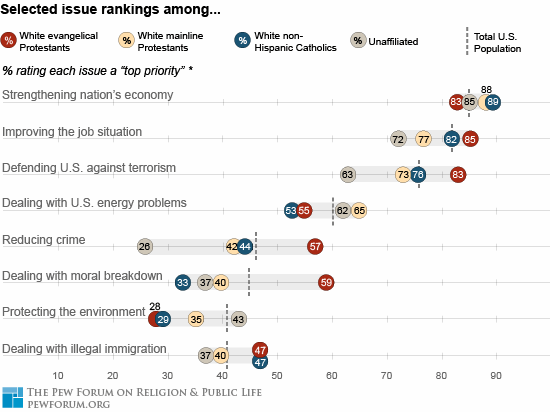
Continue reading ‘Religions Put Emphasis on Least Theological Issues’
In his commentary, AIG bonuses follow an American tradition, Julian Zelizer cites long-standing tradition as the real culprit in the AIG bonus scandal. While both parties are trying to paint the other as complicit, Zelizer makes the cogent point that the Fed’s long-standing tradition of avoidance when it comes to the management and profit-making of big business has been the real enabler.
Zelizer wrote: “In many ways, the bonus scandal was utterly predictable and would likely have happened regardless of which party was in power. And if history is a guide, the populist outrage over the bonuses may not fundamentally change the federal government’s relationship to private business. Traditionally, American politicians in times of crisis have resisted aggressive interventions by government into business which would tamper with managerial prerogatives and profits.” Continue reading ‘Government Averse to Curbing Big Business Arrogance’
I don’t normally like the “blame game”. It is, many times, used to lay blame for negative outcomes on the lowest level of management possible, so that when heads roll they are insignificant. It is a process of scape-goating – finding the lowest person on the ladder of decision-making on which the corporate sins can be laden and then slap them on the behind and send them out into the wilderness of public scrutiny. When, however, there is a systematic strategy of avoiding responsibility, laying blame where it is due becomes the method by which healing can occur. Continue reading ‘Finally, Laying Blame Where it is Due’
While there seems to be little disagreement over the dating of the prophesies of Haggai and Zechariah[1], the same cannot be said about conditions of the society to which they were delivered. To a large extent, the differences stem not so much from the content of these Biblical books as from varying ideas about the nature of the Babylonian exile of the Judeans. Knowledge of the number and societal standing of the exiles would, of course, have great bearing on the current understanding of both the returning exilic population and those remaining in Judah during the course of the seventy year dispersion. The details relating to the Judean society that can be gleaned from the pages of these prophetic books must be examined in light of the range of ideas that prevail about the previous period. Continue reading ‘Post-Exilic Community in Haggai & Zechariah 1-8’
18
Mar
09
“Abstinence Only” Rears Again
I would always prefer to avoid criticizing other religious beliefs, opting instead for simply offering an alternate view. I find myself, however, struggling in order to deal with the Pope’s stand on condom use in the battle against HIV/AIDS in a way that is not derogatory. I understand that Catholicism takes an official stand against contraception – well, that isn’t quite true – I accept that it does, even though I do not understand it. In the case of HIV/AIDS, however, the issue isn’t contraception, but the very life of millions of Africans. Continue reading ‘“Abstinence Only” Rears Again’
It’s no secret that the the American Religious Identification Survey, conducted by researchers at Trinity College of Hartford, Conn, had some interesting, if not troubling, news for U.S. churches. In a culture and age in which numbers take precedence over other indicators, the results of the survey are sending shock waves down the spines of many denominational hierarchies. As is customary, however, the concentration is on solving the numbers problem, rather than taking a good, long look at the causes. That would require collective introspection – not a process at which mainline denominations are adept. As is not uncommon, it is those outside of the fray that often give the most reasoned critique of the situation. Continue reading ‘What Do the Numbers Actually Say?’
 Rev Andy Little


Recent Comments