Posts Tagged ‘biblical authority


24
Apr
09

Soiled Goods – a Reflection on Acts 8:26-39

Reading: Acts 8:26-39

Then an angel of the Lord said to Philip, “Get up and go toward the south to the road that goes down from Jerusalem to Gaza.” (This is a wilderness road.) So he got up and went.

Now there was an Ethiopian eunuch, a court official of the Candace, queen of the Ethiopians, in charge of her entire treasury. He had come to Jerusalem to worship and was returning home; seated in his chariot, he was reading the prophet Isaiah.

 Then the Spirit said to Philip, “Go over to this chariot and join it.” So Philip ran up to it and heard him reading the prophet Isaiah. He asked, “Do you understand what you are reading?” He replied, “How can I, unless someone guides me?” And he invited Philip to get in and sit beside him. Continue reading ‘Soiled Goods – a Reflection on Acts 8:26-39’
24
Apr
09

The Parable of the Sower – Matt 13:1-23

SOWING OUR SEEDS

“Listen!”  That’s a word meant to prick up the ears of the hearer; a word meant to get people to pay attention. And where do we hear, “Listen!”, but in Jesus’ first parable in the Gospel of Matthew. (You can read the passage here.)

The parables, for me, represent in blazing color the fact that scripture is not to be taken simply at face value. It is meant to be worked through, to be wrestled with, to be mined for meaning and relevance. The parables not only defy an easy understanding, but they are designed to be thought about and reflected upon. How do we know that? From the word itself. The Greek is paraboley, and means to compare – literally “to put things beside each other”.

With this parable, we have a little easier time than with many. While the parables, in general, use concepts that would have been very meaningful to people of that time, but not so clear to us today, this one makes use of symbols that are just about universal. We hear about seed, paths, rocky soil, fertile ground – in short, we hear about agriculture. That should make it easy to understand – right? Unfortunately, it’s not that easy. Continue reading ‘The Parable of the Sower – Matt 13:1-23’

22
Apr
09

Calvin’s Spirituality – Not an Oxymoron

Within the first few pages of Elsie Anne McKee’s John Calvin – Writings on Pastoral Piety, I was stricken with disbelief. Incredibly, McKee used ‘piety’ and ‘spirituality’ interchangeably.[1]  “Now I know piety and it’s not spirituality,” I said in no uncertain terms as I looked it up in my dictionary and read “having or exhibiting religious reverence; earnestly compliant in the observance of religion; devout.”[2]  Hmmm. I then thumbed to spirituality and found “the quality or state of being spiritual; pious; heavenly-mindedness.”[3]  It appeared my negative understanding of piety as rigid, dogmatic and judgmental belief was based far too much on my early experiences with the somewhat puritanical Christian Reformed Church in Australia. Continue reading ‘Calvin’s Spirituality – Not an Oxymoron’

21
Apr
09

Integrity over Doctrine – A Brief Look at Erasmus

During the Renaissance, an age when tensions and aggressions were rising in the church, many were seeking to cling to their positions of power, prestige and wealth within the ecclesiastic structures. Reformation was brewing, both inside the Roman Catholic Church and outside, and a new age of appreciation for classicism and scholarship was developing. Critical alliances were being created and restructured between various feuding parties and the religious rift called the Protestant Reformation was materializing. Orthodox doctrine and traditional praxis were the most significant religious dimensions necessitating debates, with ecclesiology and sacraments being key elements in the discussions. At risk were the equally important treasures of eternal souls and temporal assets. Within this fray stood Erasmus, a great religious mind, exegetical thinker and biblical scholar, being courted by both sides of the battle but aligning himself fully with neither. Continue reading ‘Integrity over Doctrine – A Brief Look at Erasmus’

20
Apr
09

Imperialism, Colonialism and “Disciple-Making”

The adherents of Christian religions include upwards of 2 billion people – almost one-third of the world’s population, according to David Barrett, an Evangelical Christian who is the compiler of religious statistics for the Encyclopedia Britannica.[1] While Christianity began in the Middle East, it is generally considered a European/American religion. Those areas, however, do not encompass the majority of adherents. More Christians, in fact, are found in the “third world” – those areas that were formerly colonized by various European powers.  The story of the spread of the world’s most prolific religion during the second millennia of Christianity is at least interesting, if not informative of the current political and military efforts of the West, most notably the U.S., seemingly aimed at making converts of another sort – disciples of Western democracy and capitalism. Continue reading ‘Imperialism, Colonialism and “Disciple-Making”’

16
Apr
09

Witnessing to Our Own Culture

The reading: Luke 24:36-48.

The women returned from the tomb to tell the other disciples what they had seen and heard – Jesus was gone. They had been told by angels that Jesus had risen to fulfill what had been foretold in the law and the prophets. The women believed. But the rest of the disciples did not believe. Peter went to see for himself. We’re told that he saw the empty tomb and left questioning what had happened. Later it is recorded that Jesus appeared to him.

The disciples were still discussing this when the two disciples returned from Emmaus and related their interaction with the risen Christ. The man they met opened up the scripture – the resurrection foretold in the law and the prophets – he opened them up in their minds. They recognized the man as Jesus when he broke bread with them – they too saw, heard and ate with the risen Jesus. The disciples declared that, “Christ has risen indeed.” The fact of Jesus’ resurrection was incontrovertible – there were just too many people who had seen and heard – too much evidence.

Then in the midst of this discussion – immediately following the declaration that all believed in the resurrection of Christ – Jesus appears to them saying, “Peace be with you.” And, of course, all immediately recognized Jesus as the risen savior – they were all in wonder at this fulfillment of what had been foretold, they all saw for themselves what they knew to be true. Right?

Wrong! Continue reading ‘Witnessing to Our Own Culture’

12
Apr
09

Resurrection – Pain & Joy

Ah!  Easter Sunday!  Christ has risen.  Alleluia. 

I always imagine the early morning Easter sun breaking through the darkness of the night.  I picture the angels Mary saw dressed in white.  There she was, standing in a garden filled with the color and the smell of Easter lilies, hyacinths, and azaleas.  Okay! So it’s not exactly accurate, but it is, for me, a brilliant and dazzling scene – a scene that inspires me and brings hope.

There are substantial differences in the four Gospel versions of the resurrection story. Much has been made of these differences – perhaps more than has been made of the other differences that exist in scripture.  There are enough differences that, while each depicts a brilliant and dazzling scene, it is tough to know which, if any, may be historically accurate. Continue reading ‘Resurrection – Pain & Joy’

30
Mar
09

Wrestling with Personal Theology

Over the last few years, one of my favorite preaching topics has been the abandonment of self-interest, selfish ambition and conceit that is extolled in Philippians chapter 2. The call to humility contained within that passage culminates with “work out your own salvation with fear and trembling,” (2:12) which, I remind the congregation I am addressing, is difficult to do with someone else’s theology tucked under your arm. To be free of your own conceit requires being free of theological tenets that establish authoritarian norms of belief. It is to acknowledge that certainty is the opposite of faith, not doubt. Continue reading ‘Wrestling with Personal Theology’

30
Mar
09

A Parable based on Gen 19:1-15

             Two gay men and two lesbian women came to Sodom in the evening as Rev Lot was communing with some local folk downtown. When Rev Lot saw them, she rose to meet them and extended her hands, because she saw, in the faces of these people, the image of God – the very tired and rejected faces of Christ.  Continue reading ‘A Parable based on Gen 19:1-15’

23
Mar
09

Religions Put Emphasis on Least Theological Issues

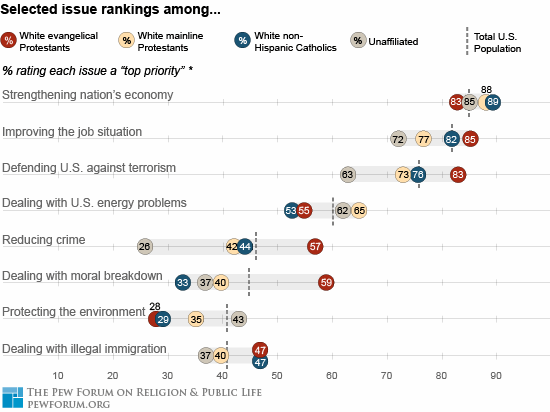
Theologically speaking, God can be found in all situations. In even the most heinous of events, we can trust God to be at least suffering with those who suffer, mourning with those who mourn and crying with those who cry. So even in this trying economic time, we can envision God’s concern for those who are worst hit by our unfolding system of commerce – the worst hit, of course, being the poorest of the poor and not particularly those whose fortune may have been trimmed by a few billion. Given this, I find interesting the results of a Pew Forum survey of religious people in which they were asked where President Obama and the legislature should concentrate their efforts. Additionally interesting, although I have yet to find an explanation, is the fact that the categories include only white religious people. We are left to surmise the purpose of that decision.

pew623

Continue reading ‘Religions Put Emphasis on Least Theological Issues’

20
Mar
09

Post-Exilic Community in Haggai & Zechariah 1-8

While there seems to be little disagreement over the dating of the prophesies of Haggai and Zechariah[1], the same cannot be said about conditions of the society to which they were delivered. To a large extent, the differences stem not so much from the content of these Biblical books as from varying ideas about the nature of the Babylonian exile of the Judeans. Knowledge of the number and societal standing of the exiles would, of course, have great bearing on the current understanding of both the returning exilic population and those remaining in Judah during the course of the seventy year dispersion. The details relating to the Judean society that can be gleaned from the pages of these prophetic books must be examined in light of the range of ideas that prevail about the previous period. Continue reading ‘Post-Exilic Community in Haggai & Zechariah 1-8’

16
Mar
09

Many Tribes or One Nation?

The Concept of Nation in Relation to Israel in the Period of the Judges.

In discussing the concept of nation within Israel’s political, social and/or religious structure during the period of the Judges it becomes imperative, first of all, to remove the obstacle of modern concepts of nationhood from the equation, in favour of attempting to determine the nature of the unity expressed by the final author(s) of Judges. To this end, this paper will try to ascertain the characteristics of the “nation” being claimed in the finished work and then decide, using existing scholarship about supporting and/or contradictory evidence within Judges, whether the claim appears valid. Separating early or core stories from the redactions that followed will help in focussing on the most likely circumstances that existed, as well as the nature and extent of the rhetoric and propaganda used by the redactor(s) to recast the period in a different light.  

Modern concepts of nation, for westerners at least, serve to confuse the issue when considering the question of whether Judges-era Israel was tribally structured or nationally united in some manner. Nationhood, in the sense of countries having sovereign and fixed national borders and central governmental structures, is a relatively modern concept for Europeans, occurring in the West only over the last three to five centuries, and one that may yet be more idealistic than true. Continue reading ‘Many Tribes or One Nation?’

14
Mar
09

Christology – Borg vs Wright

If I can be allowed a brief introduction, I have a comment about the perceived theological location of each of the authors. During 2003/2004, while attending Westminster College, Cambridge, I heard three out of four lectures given by N.T. Wright about “New Perspectives on Paul”. More interesting than the lectures was the diatribe from the various seminaries regarding Wright. The Evangelical Anglicans, conservative as opposed to traditional (self-description), denounced him as “apostasy on two legs”, while the Anglican Catholic half of the Church of England considered him a defender, albeit somewhat radical, of traditional theology in the current age. The United Reformed Church (Westminster), a mixture of very traditional (reformed) to very conservative, generally considered him to be a liberal Catholic. (All that being said, the lecture hall was packed to the rafters.) Overall, the book we’re now reading was described in Cambridge seminaries as a conversation between liberal (Wright) and very liberal (Borg). The book’s cover, claiming representation from liberal and conservative camps, seems to be heavily dependent on one’s point of view. Very few conservatives in Wright’s home country view him as anything but liberal. Still, overall it appears that both authors fit somewhere in the less-than-extreme centrist majority of the imaginary liberal-conservative spectrum and, as such, posit stands most Christians should be able to get their heads around.

Continue reading ‘Christology – Borg vs Wright’

08
Mar
09

Risking Transformation

Readings:  2 Kings 2:1-14     Mark 9:2-9

Here we have two passages about transformation. There are, obviously, links between the two. Both talk about Elijah, and each deals with a person being transformed by God in the presence of witnesses.  And it’s those witnesses I am most interested in.

Each of these principle characters had disciples. Jesus, of course, had several but only three were present – Peter, James and John. Elijah had one, Elisha. Both sets of disciples had just been told that their mentor – their master, if you will – was approaching the end of their ministries, and would soon be taken away. The reactions to these events are interestingly different, despite the similarities that exist. Continue reading ‘Risking Transformation’

05
Mar
09

I Will Be Your God, and You My People

Following an oracle about a new ethic of personal responsibility, we find in Jeremiah 31 the announcement of a new covenant: a new picture of the relationship between God and God’s people. Something ‘new’ is not a frequent theme in the Hebrew Bible until it emerges with the prophets. Parallel to the new covenant of Jeremiah, two other significant references are the ‘new thing’ and ‘the new creation’ in Isaiah 43 and 65, and the ‘new heart’ and ‘new spirit’ of Ezekiel 18.

The style of Jeremiah varies – sometimes it reads like poetry, sometimes like prose. Jeremiah was a prophet – a preacher – and he had a scribe, Baruch, who took notes for posterity. We don’t know if they intended their work to end up being part of a timeless international best-seller, but that’s what happened. Continue reading ‘I Will Be Your God, and You My People’


... or, preaching from both ends

WELL, HELLO! YOU’RE HERE.

That's too bad - I'm so sorry. Oh, well, just try to make the best of it. What you'll find here is a variety of essays and ramblings to do with things theological, social, whimsical and, sometimes, all three. I don't write to get famous - trust me, I've been told how futile that would be - but to express myself. I love to communicate and browbeat - ummm, I mean dialogue - about the things I find intriguing. Since you're here, and the door's locked, why don't you stay a while. There's a page bar under the header with links to information about us - I mean me. Don't forget to tell me what you think - in a nice way, I mean.

Readers since Jan 2009

  • 146,386 posts read

Archives