Having accepted the challenge to discuss economic theology with a Presbyterian session of a large metropolitan church, and having overheard in conversation the “ideal” minister being described as a “CEO” type, I began with a simple exercise – one I had presented several times before to different audiences. The exercise takes advantage of the preponderance of business language and processes being used by sessions and boards of religious institutions.
Posts Tagged ‘Church
28
Mar
09
God’s Economy
28
Mar
09
Anatomy of Conflict
Any group of people, whether it is a club, company, church, synagogue, association or other entity, is a body or system. While very few of the people involved may relish conflict, it is a critical component of a healthy system. Absent opposing pressures, the system will cease to function. The body serves as the best example, as almost all muscles are formed in pairs. Movement of any kind, even as simple as changing the gaze from a near point to a far point, is accomplished by the opposing mechanical processes of muscles. A healthy system recognizes the inherent value of conflict, mitigates the normal human responses of “fight or flight”, and uses the opposing pressures to create healthy and viable action. That being said, most human systems or organizations have little to no capacity for utilizing conflict constructively. Continue reading ‘Anatomy of Conflict’
25
Mar
09
The Nature of Prayer
What do I consider to be the nature of prayer? I’ve been asked many questions about prayer and people’s prayer lives, but this one caused me to really think about my answer. As it turns out, I’ve written twenty page essays on less involved topics, but will do my best to address the high spots of my thoughts.
Prayer, for me at least, fits into three categories: personal, communal and liturgical. Admittedly the last two are not neatly separated, but in my definition communal prayer is that which occurs between two or more people outside of a formal service or liturgy.
Personal prayer varies considerably but generally fits under an umbrella of “conversation with God”. Continue reading ‘The Nature of Prayer’
24
Mar
09
The Fullness of Communion
For those who are unfamiliar with the significance of the Lord’s Supper or Communion, I’d like to offer my thoughts. Since Communion is a sacrament observed by the Church, it is a little risky to assume what someone does or doesn’t know about Church, Church Mission and Membership. So, before moving into the discussion of the Lord’s Supper, I’ll spend a little time unpacking the luggage with which it travels. This is necessary because communion doesn’t exist as a separate ritual, but as an integral part of the life of the Body of Christ. It is also necessary because many ask for a quick explanation of the meaning of communion which, for the life of the church, is like asking for a short answer to the meaning of life. Without communion, church may largely lack meaning. Much of this is sourced directly, or interpreted, from the PC(USA) Book of Order. Continue reading ‘The Fullness of Communion’
Theologically speaking, God can be found in all situations. In even the most heinous of events, we can trust God to be at least suffering with those who suffer, mourning with those who mourn and crying with those who cry. So even in this trying economic time, we can envision God’s concern for those who are worst hit by our unfolding system of commerce – the worst hit, of course, being the poorest of the poor and not particularly those whose fortune may have been trimmed by a few billion. Given this, I find interesting the results of a Pew Forum survey of religious people in which they were asked where President Obama and the legislature should concentrate their efforts. Additionally interesting, although I have yet to find an explanation, is the fact that the categories include only white religious people. We are left to surmise the purpose of that decision.
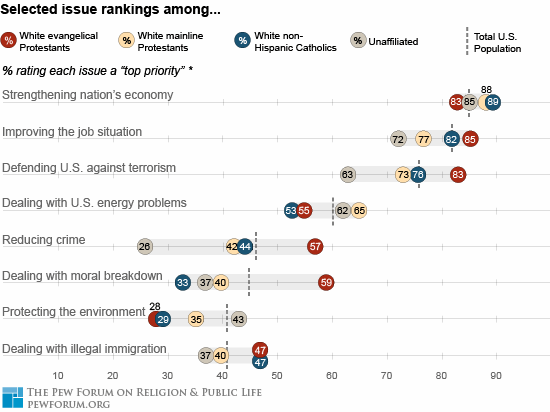
Continue reading ‘Religions Put Emphasis on Least Theological Issues’
While there seems to be little disagreement over the dating of the prophesies of Haggai and Zechariah[1], the same cannot be said about conditions of the society to which they were delivered. To a large extent, the differences stem not so much from the content of these Biblical books as from varying ideas about the nature of the Babylonian exile of the Judeans. Knowledge of the number and societal standing of the exiles would, of course, have great bearing on the current understanding of both the returning exilic population and those remaining in Judah during the course of the seventy year dispersion. The details relating to the Judean society that can be gleaned from the pages of these prophetic books must be examined in light of the range of ideas that prevail about the previous period. Continue reading ‘Post-Exilic Community in Haggai & Zechariah 1-8’
18
Mar
09
“Abstinence Only” Rears Again
I would always prefer to avoid criticizing other religious beliefs, opting instead for simply offering an alternate view. I find myself, however, struggling in order to deal with the Pope’s stand on condom use in the battle against HIV/AIDS in a way that is not derogatory. I understand that Catholicism takes an official stand against contraception – well, that isn’t quite true – I accept that it does, even though I do not understand it. In the case of HIV/AIDS, however, the issue isn’t contraception, but the very life of millions of Africans. Continue reading ‘“Abstinence Only” Rears Again’
It’s no secret that the the American Religious Identification Survey, conducted by researchers at Trinity College of Hartford, Conn, had some interesting, if not troubling, news for U.S. churches. In a culture and age in which numbers take precedence over other indicators, the results of the survey are sending shock waves down the spines of many denominational hierarchies. As is customary, however, the concentration is on solving the numbers problem, rather than taking a good, long look at the causes. That would require collective introspection – not a process at which mainline denominations are adept. As is not uncommon, it is those outside of the fray that often give the most reasoned critique of the situation. Continue reading ‘What Do the Numbers Actually Say?’
14
Mar
09
Christology – Borg vs Wright
If I can be allowed a brief introduction, I have a comment about the perceived theological location of each of the authors. During 2003/2004, while attending Westminster College, Cambridge, I heard three out of four lectures given by N.T. Wright about “New Perspectives on Paul”. More interesting than the lectures was the diatribe from the various seminaries regarding Wright. The Evangelical Anglicans, conservative as opposed to traditional (self-description), denounced him as “apostasy on two legs”, while the Anglican Catholic half of the Church of England considered him a defender, albeit somewhat radical, of traditional theology in the current age. The United Reformed Church (Westminster), a mixture of very traditional (reformed) to very conservative, generally considered him to be a liberal Catholic. (All that being said, the lecture hall was packed to the rafters.) Overall, the book we’re now reading was described in Cambridge seminaries as a conversation between liberal (Wright) and very liberal (Borg). The book’s cover, claiming representation from liberal and conservative camps, seems to be heavily dependent on one’s point of view. Very few conservatives in Wright’s home country view him as anything but liberal. Still, overall it appears that both authors fit somewhere in the less-than-extreme centrist majority of the imaginary liberal-conservative spectrum and, as such, posit stands most Christians should be able to get their heads around.
14
Mar
09
Youth See Church as Judgmental
A majority of young people in the U.S. today describe Christianity, and the Christian church generally, as judgmental and hypocritical. Many have abandoned the name “Christian” altogether because of the “baggage” that accompanies the name. A new book released by The Barna Group, which does research of and for evangelical churches, found that church attitudes about many groups of people are driving people ages 16-29 to stay away from the church.
Even churches in the “liberal tradition”-otherwise called mainline denominations-have been heatedly embroiled in debate over the exclusion of a certain segments of the population. “The Christian community’s ability to take the high road and help to deal with some of the challenges that this perception represents may be the … defining response of the Christian church in the next decade,” said David Kinnaman, Barna Group president and author of the book, UnChristian: What a New Generation Really Thinks About Christianity. Continue reading ‘Youth See Church as Judgmental’
How do nations or societies respond after periods of mass violence, indescribable episodes of systematic torture, rape and slaughter of minority or marginalized populations, or even ethnic cleansing and genocide? Historically, of course, the most common response of populations freed from such oppression has been retaliation in at least equal measure, if not more profoundly violent and obscene in character. Despite the world, in the twentieth century, experiencing atrocities of more magnitude and frequency than ever before, Martha Minow somewhat optimistically details several societal responses aimed at seeking collective healing and reconciliation. After discussing the poles of vengeance and forgiveness, Minow expounds on the strengths and limitations of legal remedies, truth commissions and efforts at reparation, before finishing with other possible efforts for reconciliation. Continue reading ‘Book Review – Between Vengeance and Forgiveness’
Paul Capetz is my one sorrow from the two years I spent at United Theological School in the Twin Cities, my alma mater. I never took a class from Paul, although I benefitted from his faith, wisdom and intellect in other ways. I have no doubt that Paul would have joined the ranks of Chris Smith, Jann Weaver, Eleazar Fernandez and Sharon Tan as exceptional teachers I have experienced first hand. Don’t get me wrong, NONE of the professors at United from whom I took classes were less than great, but these just stood out as truly inspiring. To my great disappointment, I will never know Paul firsthand as a teacher.
I could also never know, firsthand at least, the stress and agony that Paul must be feeling at the hands of an unwieldy ecclesiastical judicial process that is far better equipped at passing a “hot potato” than actually making informed, judicious decisions. Rather than fill some with awe at the intricate workings of judicial machine, which is how I have read some comments, it should fill all Presbyterians with shame. As always, the hand-wringing and juggling of important matters has a human face, and I can only imagine the agony that Paul must feel at times. Continue reading ‘Running Someone Through the Wringer … several times’
08
Mar
09
Mission Prayer
This is a prayer to be said by those going to and coming from immersion mission trips. It is a reminder to hold sacred what others trust you with, especially their hearts. Continue reading ‘Mission Prayer’
08
Mar
09
Risking Transformation
Readings: 2 Kings 2:1-14 Mark 9:2-9
Here we have two passages about transformation. There are, obviously, links between the two. Both talk about Elijah, and each deals with a person being transformed by God in the presence of witnesses. And it’s those witnesses I am most interested in.
Each of these principle characters had disciples. Jesus, of course, had several but only three were present – Peter, James and John. Elijah had one, Elisha. Both sets of disciples had just been told that their mentor – their master, if you will – was approaching the end of their ministries, and would soon be taken away. The reactions to these events are interestingly different, despite the similarities that exist. Continue reading ‘Risking Transformation’
 Rev Andy Little


 MINISTRY FROM TWO POLES
Recent Comments