Posts Tagged ‘God


31
Mar
09

Tending the Garden

Not being accustomed to gardening in the Northeast, I am somewhat amazed to see perennials starting to shoot out green in March. Past winters, except for the one spent in England a few years ago, have been suffered in less hospitable climates than upstate New York. I remember the stares of incredulity as I planted Iowa gardens before Mother’s Day, as well as covering up those plants in early May to protect them from a deep freeze. Of course, there’s nothing to say that I won’t have to do the same here.

I view gardening as one part of participating with God, in some small way, in the act of creation, Continue reading ‘Tending the Garden’

30
Mar
09

Wrestling with Personal Theology

Over the last few years, one of my favorite preaching topics has been the abandonment of self-interest, selfish ambition and conceit that is extolled in Philippians chapter 2. The call to humility contained within that passage culminates with “work out your own salvation with fear and trembling,” (2:12) which, I remind the congregation I am addressing, is difficult to do with someone else’s theology tucked under your arm. To be free of your own conceit requires being free of theological tenets that establish authoritarian norms of belief. It is to acknowledge that certainty is the opposite of faith, not doubt. Continue reading ‘Wrestling with Personal Theology’

29
Mar
09

Road Trip to Love

When driving on a long trip, the route I take depends on whether I am driving for pleasure or expediency. If my schedule is tight, needing to travel a long distance in the shortest time possible, I prefer to travel on the interstate. I want to get where I’m going quickly; I print off a map, set the cruise control, zoom past the sights and stop only when absolutely necessary. But when time is not a big factor, and the sun is shining, my priorities change. Then, I avoid the interstates whenever possible – they’re boring. I drive on state routes and even occasionally back roads, enjoy the scenery and occasionally stop in interesting towns even if I don’t need to gas up. I always have several options for getting from one place to another.

When Jenna is with me, a third way to travel sometimes develops. You see, Jenna is kind of averse to going too far without stopping to see something interesting, or to enjoy a moment of peace. Generally, she reminds me that I also need this kind of break in the journey – generally. Continue reading ‘Road Trip to Love’

26
Mar
09

Critical Life Incidents – Entering Seminary

In August 2001, I began my seminary education as a “special” student. The special classification was because I had no undergraduate degree. I was allowed to take three courses for each of two semesters, after which the admissions committee would decide if an exception to the undergraduate degree requirement would be granted.

Two seminary professors I had met in different circumstances had originally told me of the exception. Each had been aware of my interaction with students who were experiencing difficulties – some while on an immersion trip in Mexico, and another while doing her internship at a church where I worked. In each case the exception was used as a trump card when I played my “I can’t go to seminary – I don’t have a degree” card. Continue reading ‘Critical Life Incidents – Entering Seminary’

25
Mar
09

The Nature of Prayer

 What do I consider to be the nature of prayer? I’ve been asked many questions about prayer and people’s prayer lives, but this one caused me to really think about my answer. As it turns out, I’ve written twenty page essays on less involved topics, but will do my best to address the high spots of my thoughts.

Prayer, for me at least, fits into three categories: personal, communal and liturgical. Admittedly the last two are not neatly separated, but in my definition communal prayer is that which occurs between two or more people outside of a formal service or liturgy.

Personal prayer varies considerably but generally fits under an umbrella of “conversation with God”. Continue reading ‘The Nature of Prayer’

23
Mar
09

Religions Put Emphasis on Least Theological Issues

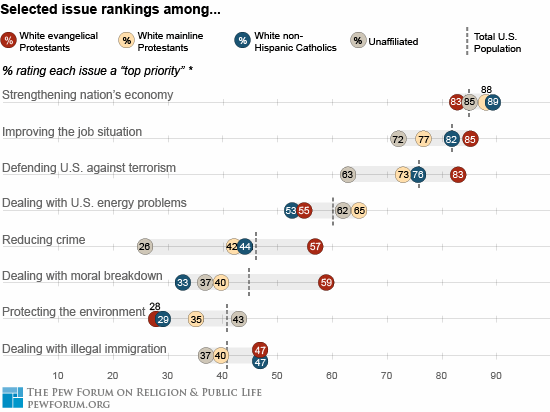
Theologically speaking, God can be found in all situations. In even the most heinous of events, we can trust God to be at least suffering with those who suffer, mourning with those who mourn and crying with those who cry. So even in this trying economic time, we can envision God’s concern for those who are worst hit by our unfolding system of commerce – the worst hit, of course, being the poorest of the poor and not particularly those whose fortune may have been trimmed by a few billion. Given this, I find interesting the results of a Pew Forum survey of religious people in which they were asked where President Obama and the legislature should concentrate their efforts. Additionally interesting, although I have yet to find an explanation, is the fact that the categories include only white religious people. We are left to surmise the purpose of that decision.

pew623

Continue reading ‘Religions Put Emphasis on Least Theological Issues’

23
Mar
09

Government Averse to Curbing Big Business Arrogance

In his commentary, AIG bonuses follow an American tradition, Julian Zelizer cites long-standing tradition as the real culprit in the AIG bonus scandal. While both parties are trying to paint the other as complicit, Zelizer makes the cogent point that the Fed’s long-standing tradition of avoidance when it comes to the management and profit-making of big business has been the real enabler.

Zelizer wrote: “In many ways, the bonus scandal was utterly predictable and would likely have happened regardless of which party was in power. And if history is a guide, the populist outrage over the bonuses may not fundamentally change the federal government’s relationship to private business. Traditionally, American politicians in times of crisis have resisted aggressive interventions by government into business which would tamper with managerial prerogatives and profits.” Continue reading ‘Government Averse to Curbing Big Business Arrogance’

20
Mar
09

Post-Exilic Community in Haggai & Zechariah 1-8

While there seems to be little disagreement over the dating of the prophesies of Haggai and Zechariah[1], the same cannot be said about conditions of the society to which they were delivered. To a large extent, the differences stem not so much from the content of these Biblical books as from varying ideas about the nature of the Babylonian exile of the Judeans. Knowledge of the number and societal standing of the exiles would, of course, have great bearing on the current understanding of both the returning exilic population and those remaining in Judah during the course of the seventy year dispersion. The details relating to the Judean society that can be gleaned from the pages of these prophetic books must be examined in light of the range of ideas that prevail about the previous period. Continue reading ‘Post-Exilic Community in Haggai & Zechariah 1-8’

18
Mar
09

What Do the Numbers Actually Say?

It’s no secret that the the American Religious Identification Survey, conducted by researchers at Trinity College of Hartford, Conn, had some interesting, if not troubling, news for U.S. churches. In a culture and age in which numbers take precedence over other indicators, the results of the survey are sending shock waves down the spines of many denominational hierarchies. As is customary, however, the concentration is on solving the numbers problem, rather than taking a good, long look at the causes. That would require collective introspection – not a process at which mainline denominations are adept. As is not uncommon, it is those outside of the fray that often give the most reasoned critique of the situation. Continue reading ‘What Do the Numbers Actually Say?’

16
Mar
09

Many Tribes or One Nation?

The Concept of Nation in Relation to Israel in the Period of the Judges.

In discussing the concept of nation within Israel’s political, social and/or religious structure during the period of the Judges it becomes imperative, first of all, to remove the obstacle of modern concepts of nationhood from the equation, in favour of attempting to determine the nature of the unity expressed by the final author(s) of Judges. To this end, this paper will try to ascertain the characteristics of the “nation” being claimed in the finished work and then decide, using existing scholarship about supporting and/or contradictory evidence within Judges, whether the claim appears valid. Separating early or core stories from the redactions that followed will help in focussing on the most likely circumstances that existed, as well as the nature and extent of the rhetoric and propaganda used by the redactor(s) to recast the period in a different light.  

Modern concepts of nation, for westerners at least, serve to confuse the issue when considering the question of whether Judges-era Israel was tribally structured or nationally united in some manner. Nationhood, in the sense of countries having sovereign and fixed national borders and central governmental structures, is a relatively modern concept for Europeans, occurring in the West only over the last three to five centuries, and one that may yet be more idealistic than true. Continue reading ‘Many Tribes or One Nation?’
14
Mar
09

Christology – Borg vs Wright

If I can be allowed a brief introduction, I have a comment about the perceived theological location of each of the authors. During 2003/2004, while attending Westminster College, Cambridge, I heard three out of four lectures given by N.T. Wright about “New Perspectives on Paul”. More interesting than the lectures was the diatribe from the various seminaries regarding Wright. The Evangelical Anglicans, conservative as opposed to traditional (self-description), denounced him as “apostasy on two legs”, while the Anglican Catholic half of the Church of England considered him a defender, albeit somewhat radical, of traditional theology in the current age. The United Reformed Church (Westminster), a mixture of very traditional (reformed) to very conservative, generally considered him to be a liberal Catholic. (All that being said, the lecture hall was packed to the rafters.) Overall, the book we’re now reading was described in Cambridge seminaries as a conversation between liberal (Wright) and very liberal (Borg). The book’s cover, claiming representation from liberal and conservative camps, seems to be heavily dependent on one’s point of view. Very few conservatives in Wright’s home country view him as anything but liberal. Still, overall it appears that both authors fit somewhere in the less-than-extreme centrist majority of the imaginary liberal-conservative spectrum and, as such, posit stands most Christians should be able to get their heads around.

Continue reading ‘Christology – Borg vs Wright’

08
Mar
09

Risking Transformation

Readings:  2 Kings 2:1-14     Mark 9:2-9

Here we have two passages about transformation. There are, obviously, links between the two. Both talk about Elijah, and each deals with a person being transformed by God in the presence of witnesses.  And it’s those witnesses I am most interested in.

Each of these principle characters had disciples. Jesus, of course, had several but only three were present – Peter, James and John. Elijah had one, Elisha. Both sets of disciples had just been told that their mentor – their master, if you will – was approaching the end of their ministries, and would soon be taken away. The reactions to these events are interestingly different, despite the similarities that exist. Continue reading ‘Risking Transformation’

05
Mar
09

I Will Be Your God, and You My People

Following an oracle about a new ethic of personal responsibility, we find in Jeremiah 31 the announcement of a new covenant: a new picture of the relationship between God and God’s people. Something ‘new’ is not a frequent theme in the Hebrew Bible until it emerges with the prophets. Parallel to the new covenant of Jeremiah, two other significant references are the ‘new thing’ and ‘the new creation’ in Isaiah 43 and 65, and the ‘new heart’ and ‘new spirit’ of Ezekiel 18.

The style of Jeremiah varies – sometimes it reads like poetry, sometimes like prose. Jeremiah was a prophet – a preacher – and he had a scribe, Baruch, who took notes for posterity. We don’t know if they intended their work to end up being part of a timeless international best-seller, but that’s what happened. Continue reading ‘I Will Be Your God, and You My People’

04
Mar
09

The Scandal of Jesus Christ – Three Perspectives

For much of the last two thousand years there have been scandals associated with, or hindrances to, belief in Jesus Christ as savior. What is so outrageous about the claim of salvation in Jesus that offends the moral or rational sensibilities of at least certain segments of society? In examining this question, three authors – Jan Milic Lochman, Elizabeth A. Johnson and Justo L. González – discussed the traditional orthodox views of salvation through faith in Christ in light of modern interests. The authors had particular agendas, openly declared in each of their works, around which they developed their arguments. These various arguments were in close agreement at some points and in discord at others but, when viewed collectively, created an interesting sampling of some of the opinions that make up modern Christian thought. Continue reading ‘The Scandal of Jesus Christ – Three Perspectives’

17
Feb
09

But, How Do I Know I Will Possess It?

The Reading:  Genesis 15:1-12,17-18

Setting The Theme:

God cut a covenant with Abram. While I realize much can be made of the nature of this covenant, I also know that I am addressing people who have already wrestled with these implications. Some have expounded on the unilateral nature of this covenant – that God is the only participant. Some have gone further and said that God has taken all the risk of the penalty – an utterly humiliating death – for both parties in the contract. From there it is not difficult to see the trail being blazed to Christ on the cross.

If I had the definitive answer to this conundrum, I think I would still be unlikely to change the minds of many people. Since I don’t have the answer, I am not even going to try.

The reason for the covenant is rather more interesting. What prompted it? Continue reading ‘But, How Do I Know I Will Possess It?’


... or, preaching from both ends

WELL, HELLO! YOU’RE HERE.

That's too bad - I'm so sorry. Oh, well, just try to make the best of it. What you'll find here is a variety of essays and ramblings to do with things theological, social, whimsical and, sometimes, all three. I don't write to get famous - trust me, I've been told how futile that would be - but to express myself. I love to communicate and browbeat - ummm, I mean dialogue - about the things I find intriguing. Since you're here, and the door's locked, why don't you stay a while. There's a page bar under the header with links to information about us - I mean me. Don't forget to tell me what you think - in a nice way, I mean.

Readers since Jan 2009

  • 146,386 posts read

Archives