
Posts Tagged ‘poverty
24
Apr
09
Thanks, Emproph
SOWING OUR SEEDS
“Listen!” That’s a word meant to prick up the ears of the hearer; a word meant to get people to pay attention. And where do we hear, “Listen!”, but in Jesus’ first parable in the Gospel of Matthew. (You can read the passage here.)
The parables, for me, represent in blazing color the fact that scripture is not to be taken simply at face value. It is meant to be worked through, to be wrestled with, to be mined for meaning and relevance. The parables not only defy an easy understanding, but they are designed to be thought about and reflected upon. How do we know that? From the word itself. The Greek is paraboley, and means to compare – literally “to put things beside each other”.
With this parable, we have a little easier time than with many. While the parables, in general, use concepts that would have been very meaningful to people of that time, but not so clear to us today, this one makes use of symbols that are just about universal. We hear about seed, paths, rocky soil, fertile ground – in short, we hear about agriculture. That should make it easy to understand – right? Unfortunately, it’s not that easy. Continue reading ‘The Parable of the Sower – Matt 13:1-23’
Within the first few pages of Elsie Anne McKee’s John Calvin – Writings on Pastoral Piety, I was stricken with disbelief. Incredibly, McKee used ‘piety’ and ‘spirituality’ interchangeably.[1] “Now I know piety and it’s not spirituality,” I said in no uncertain terms as I looked it up in my dictionary and read “having or exhibiting religious reverence; earnestly compliant in the observance of religion; devout.”[2] Hmmm. I then thumbed to spirituality and found “the quality or state of being spiritual; pious; heavenly-mindedness.”[3] It appeared my negative understanding of piety as rigid, dogmatic and judgmental belief was based far too much on my early experiences with the somewhat puritanical Christian Reformed Church in Australia. Continue reading ‘Calvin’s Spirituality – Not an Oxymoron’
The adherents of Christian religions include upwards of 2 billion people – almost one-third of the world’s population, according to David Barrett, an Evangelical Christian who is the compiler of religious statistics for the Encyclopedia Britannica.[1] While Christianity began in the Middle East, it is generally considered a European/American religion. Those areas, however, do not encompass the majority of adherents. More Christians, in fact, are found in the “third world” – those areas that were formerly colonized by various European powers. The story of the spread of the world’s most prolific religion during the second millennia of Christianity is at least interesting, if not informative of the current political and military efforts of the West, most notably the U.S., seemingly aimed at making converts of another sort – disciples of Western democracy and capitalism. Continue reading ‘Imperialism, Colonialism and “Disciple-Making”’
16
Apr
09
Witnessing to Our Own Culture
The reading: Luke 24:36-48.
The women returned from the tomb to tell the other disciples what they had seen and heard – Jesus was gone. They had been told by angels that Jesus had risen to fulfill what had been foretold in the law and the prophets. The women believed. But the rest of the disciples did not believe. Peter went to see for himself. We’re told that he saw the empty tomb and left questioning what had happened. Later it is recorded that Jesus appeared to him.
The disciples were still discussing this when the two disciples returned from Emmaus and related their interaction with the risen Christ. The man they met opened up the scripture – the resurrection foretold in the law and the prophets – he opened them up in their minds. They recognized the man as Jesus when he broke bread with them – they too saw, heard and ate with the risen Jesus. The disciples declared that, “Christ has risen indeed.” The fact of Jesus’ resurrection was incontrovertible – there were just too many people who had seen and heard – too much evidence.
Then in the midst of this discussion – immediately following the declaration that all believed in the resurrection of Christ – Jesus appears to them saying, “Peace be with you.” And, of course, all immediately recognized Jesus as the risen savior – they were all in wonder at this fulfillment of what had been foretold, they all saw for themselves what they knew to be true. Right?
12
Apr
09
Resurrection – Pain & Joy
Ah! Easter Sunday! Christ has risen. Alleluia.
I always imagine the early morning Easter sun breaking through the darkness of the night. I picture the angels Mary saw dressed in white. There she was, standing in a garden filled with the color and the smell of Easter lilies, hyacinths, and azaleas. Okay! So it’s not exactly accurate, but it is, for me, a brilliant and dazzling scene – a scene that inspires me and brings hope.
There are substantial differences in the four Gospel versions of the resurrection story. Much has been made of these differences – perhaps more than has been made of the other differences that exist in scripture. There are enough differences that, while each depicts a brilliant and dazzling scene, it is tough to know which, if any, may be historically accurate. Continue reading ‘Resurrection – Pain & Joy’
11
Apr
09
Post-Christian or Pro-Christlike
” “A remarkable culture-shift has taken place around us,” Mohler [R. Albert Mohler Jr.—president of the Southern Baptist Theological Seminary] wrote. “The most basic contours of American culture have been radically altered. The so-called Judeo-Christian consensus of the last millennium has given way to a post-modern, post-Christian, post-Western cultural crisis which threatens the very heart of our culture.” When Mohler and I spoke in the days after he wrote this, he had grown even gloomier. “Clearly, there is a new narrative, a post-Christian narrative, that is animating large portions of this society,” he said from his office on campus in Louisville, Ky. ” Quoted from Jon Meacham’s The End of Christian America.
My good friend, Daniel, posted a link on Soulforce.org to the above article in order to start a conversation about what “Post-Christian” might mean. Daniel, a former Assembly of God member now more comfortable with Buddha, has an attitude about Christianity that may best be descibed using Gandhi’s statement, “I like your Christ, I do not like your Christians. Your Christians are so unlike your Christ.” Continue reading ‘Post-Christian or Pro-Christlike’
31
Mar
09
Homophobia, Apartheid, et al
Periodically, I suffer from the delusion that culture and society can actually be understood, and that I can speak with some knowledge towards that understanding. This fabrication in my mind, fortunately, passes with time, saving poor innocent bystanders the terror of witnessing the inner workings of my mind. Alas, this is not one of those times.
Reader beware! These may be nothing more than the ramblings of a madman.
I am recovering from my former life – being a recovering addict, recovering economic exploiter, recovering sexist, recovering racist and recovering homophobe. In my newer life, I am a combatant in a war against all manner of exploitation, oppression, manipulation and dehumanization of any and all people. There is, as you know, no worse critic that someone recovering from a particular expression of a disorder. Continue reading ‘Homophobia, Apartheid, et al’
28
Mar
09
God’s Economy
Having accepted the challenge to discuss economic theology with a Presbyterian session of a large metropolitan church, and having overheard in conversation the “ideal” minister being described as a “CEO” type, I began with a simple exercise – one I had presented several times before to different audiences. The exercise takes advantage of the preponderance of business language and processes being used by sessions and boards of religious institutions.
Theologically speaking, God can be found in all situations. In even the most heinous of events, we can trust God to be at least suffering with those who suffer, mourning with those who mourn and crying with those who cry. So even in this trying economic time, we can envision God’s concern for those who are worst hit by our unfolding system of commerce – the worst hit, of course, being the poorest of the poor and not particularly those whose fortune may have been trimmed by a few billion. Given this, I find interesting the results of a Pew Forum survey of religious people in which they were asked where President Obama and the legislature should concentrate their efforts. Additionally interesting, although I have yet to find an explanation, is the fact that the categories include only white religious people. We are left to surmise the purpose of that decision.
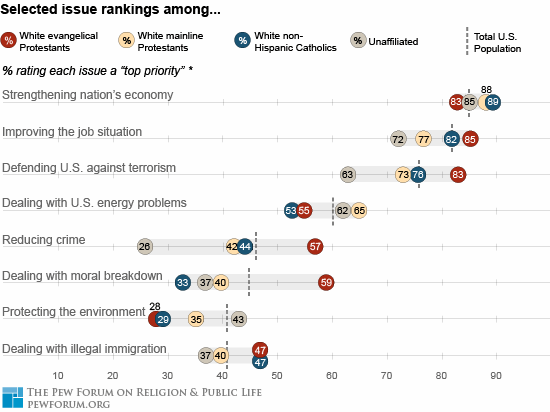
Continue reading ‘Religions Put Emphasis on Least Theological Issues’
In his commentary, AIG bonuses follow an American tradition, Julian Zelizer cites long-standing tradition as the real culprit in the AIG bonus scandal. While both parties are trying to paint the other as complicit, Zelizer makes the cogent point that the Fed’s long-standing tradition of avoidance when it comes to the management and profit-making of big business has been the real enabler.
Zelizer wrote: “In many ways, the bonus scandal was utterly predictable and would likely have happened regardless of which party was in power. And if history is a guide, the populist outrage over the bonuses may not fundamentally change the federal government’s relationship to private business. Traditionally, American politicians in times of crisis have resisted aggressive interventions by government into business which would tamper with managerial prerogatives and profits.” Continue reading ‘Government Averse to Curbing Big Business Arrogance’
While there seems to be little disagreement over the dating of the prophesies of Haggai and Zechariah[1], the same cannot be said about conditions of the society to which they were delivered. To a large extent, the differences stem not so much from the content of these Biblical books as from varying ideas about the nature of the Babylonian exile of the Judeans. Knowledge of the number and societal standing of the exiles would, of course, have great bearing on the current understanding of both the returning exilic population and those remaining in Judah during the course of the seventy year dispersion. The details relating to the Judean society that can be gleaned from the pages of these prophetic books must be examined in light of the range of ideas that prevail about the previous period. Continue reading ‘Post-Exilic Community in Haggai & Zechariah 1-8’
18
Mar
09
“Abstinence Only” Rears Again
I would always prefer to avoid criticizing other religious beliefs, opting instead for simply offering an alternate view. I find myself, however, struggling in order to deal with the Pope’s stand on condom use in the battle against HIV/AIDS in a way that is not derogatory. I understand that Catholicism takes an official stand against contraception – well, that isn’t quite true – I accept that it does, even though I do not understand it. In the case of HIV/AIDS, however, the issue isn’t contraception, but the very life of millions of Africans. Continue reading ‘“Abstinence Only” Rears Again’
08
Mar
09
Mission Prayer
This is a prayer to be said by those going to and coming from immersion mission trips. It is a reminder to hold sacred what others trust you with, especially their hearts. Continue reading ‘Mission Prayer’
03
Mar
09
What Must Our Children Think
I’ll think about the following the next time I hear someone say something about the “younger generation.”
There are some interesting statistics – nay, absolutely awful ones – from a CNN article this morning. According to the Pew Center on the States, there were 7.3 million adults incarcerated in this country during 2007. A synopsis of the statistical findings should raise a lot of questions:
That is over 3 out of every 100 people in the country.
People of color were disproportionately more represented than whites – over 9 per 100 of black adults and more than 5 per 100 of Hispanic or Latino adults.
Maybe that doesn’t sound too bad to you, Continue reading ‘What Must Our Children Think’
 Rev Andy Little


 MINISTRY FROM TWO POLES
Recent Comments