Posts Tagged ‘conflict resolution


16
Apr
09

Witnessing to Our Own Culture

The reading: Luke 24:36-48.

The women returned from the tomb to tell the other disciples what they had seen and heard – Jesus was gone. They had been told by angels that Jesus had risen to fulfill what had been foretold in the law and the prophets. The women believed. But the rest of the disciples did not believe. Peter went to see for himself. We’re told that he saw the empty tomb and left questioning what had happened. Later it is recorded that Jesus appeared to him.

The disciples were still discussing this when the two disciples returned from Emmaus and related their interaction with the risen Christ. The man they met opened up the scripture – the resurrection foretold in the law and the prophets – he opened them up in their minds. They recognized the man as Jesus when he broke bread with them – they too saw, heard and ate with the risen Jesus. The disciples declared that, “Christ has risen indeed.” The fact of Jesus’ resurrection was incontrovertible – there were just too many people who had seen and heard – too much evidence.

Then in the midst of this discussion – immediately following the declaration that all believed in the resurrection of Christ – Jesus appears to them saying, “Peace be with you.” And, of course, all immediately recognized Jesus as the risen savior – they were all in wonder at this fulfillment of what had been foretold, they all saw for themselves what they knew to be true. Right?
Wrong! Continue reading ‘Witnessing to Our Own Culture’

12
Apr
09

Resurrection – Pain & Joy

Ah!  Easter Sunday!  Christ has risen.  Alleluia. 

I always imagine the early morning Easter sun breaking through the darkness of the night.  I picture the angels Mary saw dressed in white.  There she was, standing in a garden filled with the color and the smell of Easter lilies, hyacinths, and azaleas.  Okay! So it’s not exactly accurate, but it is, for me, a brilliant and dazzling scene – a scene that inspires me and brings hope.

There are substantial differences in the four Gospel versions of the resurrection story. Much has been made of these differences – perhaps more than has been made of the other differences that exist in scripture.  There are enough differences that, while each depicts a brilliant and dazzling scene, it is tough to know which, if any, may be historically accurate. Continue reading ‘Resurrection – Pain & Joy’

11
Apr
09

Post-Christian or Pro-Christlike

“A remarkable culture-shift has taken place around us,” Mohler [R. Albert Mohler Jr.—president of the Southern Baptist Theological Seminary] wrote. “The most basic contours of American culture have been radically altered. The so-called Judeo-Christian consensus of the last millennium has given way to a post-modern, post-Christian, post-Western cultural crisis which threatens the very heart of our culture.” When Mohler and I spoke in the days after he wrote this, he had grown even gloomier. “Clearly, there is a new narrative, a post-Christian narrative, that is animating large portions of this society,” he said from his office on campus in Louisville, Ky. ” Quoted from Jon Meacham’s The End of Christian America.

My good friend, Daniel, posted a link on Soulforce.org to the above article in order to start a conversation about what “Post-Christian” might mean. Daniel, a former Assembly of God member now more comfortable with Buddha, has an attitude about Christianity that may best be descibed using Gandhi’s statement, “I like your Christ, I do not like your Christians. Your Christians are so unlike your Christ.” Continue reading ‘Post-Christian or Pro-Christlike’

31
Mar
09

Homophobia, Apartheid, et al

           Periodically, I suffer from the delusion that culture and society can actually be understood, and that I can speak with some knowledge towards that understanding. This fabrication in my mind, fortunately, passes with time, saving poor innocent bystanders the terror of witnessing the inner workings of my mind. Alas, this is not one of those times.

Reader beware! These may be nothing more than the ramblings of a madman.

           I am recovering from my former life – being a recovering addict, recovering economic exploiter, recovering sexist, recovering racist and recovering homophobe. In my newer life, I am a combatant in a war against all manner of exploitation, oppression, manipulation and dehumanization of any and all people. There is, as you know, no worse critic that someone recovering from a particular expression of a disorder. Continue reading ‘Homophobia, Apartheid, et al’

29
Mar
09

Covenant Stressed

COVENANT STRESSED – Why Ministers and Laity Leave Church

Much has been written, over the last several years especially, about the level of stress experienced by clergy. Stressors are cited as reasons for clergy infidelity, sexual misconduct, power abuse and the number of professionals leaving ministry. Conflict, usually at the local church level, is the most common type of stressor cited. Quite understandably, much of the work done in this area of study uses the techniques and language of sociology and psychology. Covenant, however, is not a concept strictly, or even commonly, associated with either of these disciplines, while it is a central tenet of the bulk of Christian pastoral effort. Covenant is a mutual relationship. Church members, clergy and officers are equally important in the relationships of the church, and can fall prey to exactly the same kinds of stresses. In my estimation, studying the role of covenants, or rather broken covenants, might yield far more meaningful results for understanding church stress generally, and the reason so many leave the church specifically. Continue reading ‘Covenant Stressed’

28
Mar
09

Anatomy of Conflict

Any group of people, whether it is a club, company, church, synagogue, association or other entity, is a body or system. While very few of the people involved may relish conflict, it is a critical component of a healthy system. Absent opposing pressures, the system will cease to function. The body serves as the best example, as almost all muscles are formed in pairs. Movement of any kind, even as simple as changing the gaze from a near point to a far point, is accomplished by the opposing mechanical processes of muscles. A healthy system recognizes the inherent value of conflict, mitigates the normal human responses of “fight or flight”, and uses the opposing pressures to create healthy and viable action. That being said, most human systems or organizations have little to no capacity for utilizing conflict constructively. Continue reading ‘Anatomy of Conflict’

26
Mar
09

Critical Life Incidents – Entering Seminary

In August 2001, I began my seminary education as a “special” student. The special classification was because I had no undergraduate degree. I was allowed to take three courses for each of two semesters, after which the admissions committee would decide if an exception to the undergraduate degree requirement would be granted.

Two seminary professors I had met in different circumstances had originally told me of the exception. Each had been aware of my interaction with students who were experiencing difficulties – some while on an immersion trip in Mexico, and another while doing her internship at a church where I worked. In each case the exception was used as a trump card when I played my “I can’t go to seminary – I don’t have a degree” card. Continue reading ‘Critical Life Incidents – Entering Seminary’

23
Mar
09

Religions Put Emphasis on Least Theological Issues

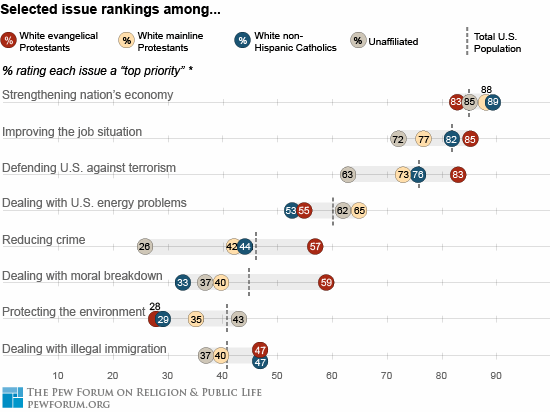
Theologically speaking, God can be found in all situations. In even the most heinous of events, we can trust God to be at least suffering with those who suffer, mourning with those who mourn and crying with those who cry. So even in this trying economic time, we can envision God’s concern for those who are worst hit by our unfolding system of commerce – the worst hit, of course, being the poorest of the poor and not particularly those whose fortune may have been trimmed by a few billion. Given this, I find interesting the results of a Pew Forum survey of religious people in which they were asked where President Obama and the legislature should concentrate their efforts. Additionally interesting, although I have yet to find an explanation, is the fact that the categories include only white religious people. We are left to surmise the purpose of that decision.

pew623

Continue reading ‘Religions Put Emphasis on Least Theological Issues’

21
Mar
09

Finally, Laying Blame Where it is Due

I don’t normally like the “blame game”. It is, many times, used to lay blame for negative outcomes on the lowest level of management possible, so that when heads roll they are insignificant. It is a process of scape-goating – finding the lowest person on the ladder of decision-making on which the corporate sins can be laden and then slap them on the behind and send them out into the wilderness of public scrutiny. When, however, there is a systematic strategy of avoiding responsibility, laying blame where it is due becomes the method by which healing can occur. Continue reading ‘Finally, Laying Blame Where it is Due’

20
Mar
09

Post-Exilic Community in Haggai & Zechariah 1-8

While there seems to be little disagreement over the dating of the prophesies of Haggai and Zechariah[1], the same cannot be said about conditions of the society to which they were delivered. To a large extent, the differences stem not so much from the content of these Biblical books as from varying ideas about the nature of the Babylonian exile of the Judeans. Knowledge of the number and societal standing of the exiles would, of course, have great bearing on the current understanding of both the returning exilic population and those remaining in Judah during the course of the seventy year dispersion. The details relating to the Judean society that can be gleaned from the pages of these prophetic books must be examined in light of the range of ideas that prevail about the previous period. Continue reading ‘Post-Exilic Community in Haggai & Zechariah 1-8’

18
Mar
09

What Do the Numbers Actually Say?

It’s no secret that the the American Religious Identification Survey, conducted by researchers at Trinity College of Hartford, Conn, had some interesting, if not troubling, news for U.S. churches. In a culture and age in which numbers take precedence over other indicators, the results of the survey are sending shock waves down the spines of many denominational hierarchies. As is customary, however, the concentration is on solving the numbers problem, rather than taking a good, long look at the causes. That would require collective introspection – not a process at which mainline denominations are adept. As is not uncommon, it is those outside of the fray that often give the most reasoned critique of the situation. Continue reading ‘What Do the Numbers Actually Say?’

12
Mar
09

Book Review – Between Vengeance and Forgiveness

How do nations or societies respond after periods of mass violence, indescribable episodes of systematic torture, rape and slaughter of minority or marginalized populations, or even ethnic cleansing and genocide?  Historically, of course, the most common response of populations freed from such oppression has been retaliation in at least equal measure, if not more profoundly violent and obscene in character. Despite the world, in the twentieth century, experiencing atrocities of more magnitude and frequency than ever before, Martha Minow somewhat optimistically details several societal responses aimed at seeking collective healing and reconciliation. After discussing the poles of vengeance and forgiveness, Minow expounds on the strengths and limitations of legal remedies, truth commissions and efforts at reparation, before finishing with other possible efforts for reconciliation. Continue reading ‘Book Review – Between Vengeance and Forgiveness’

12
Mar
09

Running Someone Through the Wringer … several times

Paul Capetz is my one sorrow from the two years I spent at United Theological School in the Twin Cities, my alma mater. I never took a class from Paul, although I benefitted from his faith, wisdom and intellect in other ways. I have no doubt that Paul would have joined the ranks of Chris Smith, Jann Weaver, Eleazar Fernandez and Sharon Tan as exceptional teachers I have experienced first hand. Don’t get me wrong, NONE of the professors at United from whom I took classes were less than great, but these just stood out as truly inspiring. To my great disappointment, I will never know Paul firsthand as a teacher.

I could also never know, firsthand at least, the stress and agony that Paul must be feeling at the hands of an unwieldy ecclesiastical judicial process that is far better equipped at passing a “hot potato” than actually making informed, judicious decisions. Rather than fill some with awe at the intricate workings of judicial machine, which is how I have read some comments, it should fill all Presbyterians with shame. As always, the hand-wringing and juggling of important matters has a human face, and I can only imagine the agony that Paul must feel at times. Continue reading ‘Running Someone Through the Wringer … several times’

08
Mar
09

Risking Transformation

Readings:  2 Kings 2:1-14     Mark 9:2-9

Here we have two passages about transformation. There are, obviously, links between the two. Both talk about Elijah, and each deals with a person being transformed by God in the presence of witnesses.  And it’s those witnesses I am most interested in.

Each of these principle characters had disciples. Jesus, of course, had several but only three were present – Peter, James and John. Elijah had one, Elisha. Both sets of disciples had just been told that their mentor – their master, if you will – was approaching the end of their ministries, and would soon be taken away. The reactions to these events are interestingly different, despite the similarities that exist. Continue reading ‘Risking Transformation’

04
Mar
09

Right (Re)Defining “Bashing”

“BASHING”a word that has long been used by minorities to describe the actions of mobs and people motivated by hate. Some on the religious-right, because of the attention on gay bashing, have started to appropriate this word to talk about how they are being discriminated against. This video is potentially troubling because of some fo the images, but is a must see for those who wish to understand how the word “bashing” in being co-opted and watered down. Continue reading ‘Right (Re)Defining “Bashing”’


... or, preaching from both ends

WELL, HELLO! YOU’RE HERE.

That's too bad - I'm so sorry. Oh, well, just try to make the best of it. What you'll find here is a variety of essays and ramblings to do with things theological, social, whimsical and, sometimes, all three. I don't write to get famous - trust me, I've been told how futile that would be - but to express myself. I love to communicate and browbeat - ummm, I mean dialogue - about the things I find intriguing. Since you're here, and the door's locked, why don't you stay a while. There's a page bar under the header with links to information about us - I mean me. Don't forget to tell me what you think - in a nice way, I mean.

Readers since Jan 2009

  • 145,747 posts read

Archives