Having accepted the challenge to discuss economic theology with a Presbyterian session of a large metropolitan church, and having overheard in conversation the “ideal” minister being described as a “CEO” type, I began with a simple exercise – one I had presented several times before to different audiences. The exercise takes advantage of the preponderance of business language and processes being used by sessions and boards of religious institutions.
Posts Tagged ‘cultural competence
28
Mar
09
God’s Economy
28
Mar
09
Anatomy of Conflict
Any group of people, whether it is a club, company, church, synagogue, association or other entity, is a body or system. While very few of the people involved may relish conflict, it is a critical component of a healthy system. Absent opposing pressures, the system will cease to function. The body serves as the best example, as almost all muscles are formed in pairs. Movement of any kind, even as simple as changing the gaze from a near point to a far point, is accomplished by the opposing mechanical processes of muscles. A healthy system recognizes the inherent value of conflict, mitigates the normal human responses of “fight or flight”, and uses the opposing pressures to create healthy and viable action. That being said, most human systems or organizations have little to no capacity for utilizing conflict constructively. Continue reading ‘Anatomy of Conflict’
Theologically speaking, God can be found in all situations. In even the most heinous of events, we can trust God to be at least suffering with those who suffer, mourning with those who mourn and crying with those who cry. So even in this trying economic time, we can envision God’s concern for those who are worst hit by our unfolding system of commerce – the worst hit, of course, being the poorest of the poor and not particularly those whose fortune may have been trimmed by a few billion. Given this, I find interesting the results of a Pew Forum survey of religious people in which they were asked where President Obama and the legislature should concentrate their efforts. Additionally interesting, although I have yet to find an explanation, is the fact that the categories include only white religious people. We are left to surmise the purpose of that decision.
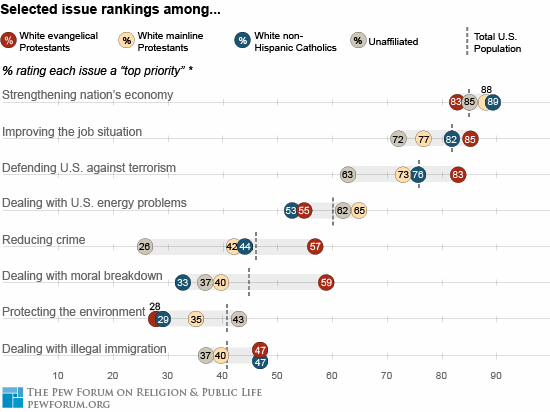
Continue reading ‘Religions Put Emphasis on Least Theological Issues’
In his commentary, AIG bonuses follow an American tradition, Julian Zelizer cites long-standing tradition as the real culprit in the AIG bonus scandal. While both parties are trying to paint the other as complicit, Zelizer makes the cogent point that the Fed’s long-standing tradition of avoidance when it comes to the management and profit-making of big business has been the real enabler.
Zelizer wrote: “In many ways, the bonus scandal was utterly predictable and would likely have happened regardless of which party was in power. And if history is a guide, the populist outrage over the bonuses may not fundamentally change the federal government’s relationship to private business. Traditionally, American politicians in times of crisis have resisted aggressive interventions by government into business which would tamper with managerial prerogatives and profits.” Continue reading ‘Government Averse to Curbing Big Business Arrogance’
I don’t normally like the “blame game”. It is, many times, used to lay blame for negative outcomes on the lowest level of management possible, so that when heads roll they are insignificant. It is a process of scape-goating – finding the lowest person on the ladder of decision-making on which the corporate sins can be laden and then slap them on the behind and send them out into the wilderness of public scrutiny. When, however, there is a systematic strategy of avoiding responsibility, laying blame where it is due becomes the method by which healing can occur. Continue reading ‘Finally, Laying Blame Where it is Due’
While there seems to be little disagreement over the dating of the prophesies of Haggai and Zechariah[1], the same cannot be said about conditions of the society to which they were delivered. To a large extent, the differences stem not so much from the content of these Biblical books as from varying ideas about the nature of the Babylonian exile of the Judeans. Knowledge of the number and societal standing of the exiles would, of course, have great bearing on the current understanding of both the returning exilic population and those remaining in Judah during the course of the seventy year dispersion. The details relating to the Judean society that can be gleaned from the pages of these prophetic books must be examined in light of the range of ideas that prevail about the previous period. Continue reading ‘Post-Exilic Community in Haggai & Zechariah 1-8’
It’s no secret that the the American Religious Identification Survey, conducted by researchers at Trinity College of Hartford, Conn, had some interesting, if not troubling, news for U.S. churches. In a culture and age in which numbers take precedence over other indicators, the results of the survey are sending shock waves down the spines of many denominational hierarchies. As is customary, however, the concentration is on solving the numbers problem, rather than taking a good, long look at the causes. That would require collective introspection – not a process at which mainline denominations are adept. As is not uncommon, it is those outside of the fray that often give the most reasoned critique of the situation. Continue reading ‘What Do the Numbers Actually Say?’
14
Mar
09
Youth See Church as Judgmental
A majority of young people in the U.S. today describe Christianity, and the Christian church generally, as judgmental and hypocritical. Many have abandoned the name “Christian” altogether because of the “baggage” that accompanies the name. A new book released by The Barna Group, which does research of and for evangelical churches, found that church attitudes about many groups of people are driving people ages 16-29 to stay away from the church.
Even churches in the “liberal tradition”-otherwise called mainline denominations-have been heatedly embroiled in debate over the exclusion of a certain segments of the population. “The Christian community’s ability to take the high road and help to deal with some of the challenges that this perception represents may be the … defining response of the Christian church in the next decade,” said David Kinnaman, Barna Group president and author of the book, UnChristian: What a New Generation Really Thinks About Christianity. Continue reading ‘Youth See Church as Judgmental’
How do nations or societies respond after periods of mass violence, indescribable episodes of systematic torture, rape and slaughter of minority or marginalized populations, or even ethnic cleansing and genocide? Historically, of course, the most common response of populations freed from such oppression has been retaliation in at least equal measure, if not more profoundly violent and obscene in character. Despite the world, in the twentieth century, experiencing atrocities of more magnitude and frequency than ever before, Martha Minow somewhat optimistically details several societal responses aimed at seeking collective healing and reconciliation. After discussing the poles of vengeance and forgiveness, Minow expounds on the strengths and limitations of legal remedies, truth commissions and efforts at reparation, before finishing with other possible efforts for reconciliation. Continue reading ‘Book Review – Between Vengeance and Forgiveness’
08
Mar
09
Mission Prayer
This is a prayer to be said by those going to and coming from immersion mission trips. It is a reminder to hold sacred what others trust you with, especially their hearts. Continue reading ‘Mission Prayer’
08
Mar
09
Risking Transformation
Readings: 2 Kings 2:1-14 Mark 9:2-9
Here we have two passages about transformation. There are, obviously, links between the two. Both talk about Elijah, and each deals with a person being transformed by God in the presence of witnesses. And it’s those witnesses I am most interested in.
Each of these principle characters had disciples. Jesus, of course, had several but only three were present – Peter, James and John. Elijah had one, Elisha. Both sets of disciples had just been told that their mentor – their master, if you will – was approaching the end of their ministries, and would soon be taken away. The reactions to these events are interestingly different, despite the similarities that exist. Continue reading ‘Risking Transformation’
04
Mar
09
Right (Re)Defining “Bashing”
“BASHING” – a word that has long been used by minorities to describe the actions of mobs and people motivated by hate. Some on the religious-right, because of the attention on gay bashing, have started to appropriate this word to talk about how they are being discriminated against. This video is potentially troubling because of some fo the images, but is a must see for those who wish to understand how the word “bashing” in being co-opted and watered down. Continue reading ‘Right (Re)Defining “Bashing”’
03
Mar
09
Doth Thou Protesteth Too Much?
There was an interesting study recently released that measures the appetite for pornography based on scales of religious and social conservatism. The results of this survey are not surprising when compared to other results released years ago.
In the old report, arousal was measured in men, who self-identified from very anti-LGBT to liberal, when they watched “gay porn.” Not surprisingly, those who had the most negative attitude about GLBT had more erectile arousal than those who had less. The results of the survey showed that homophobia is as or more likely to be caused by shame and suppression of innate homosexual tendencies as any other cause.
This recent survey, and the summary article in New Scientist, seems to show a similar pattern Continue reading ‘Doth Thou Protesteth Too Much?’
If you are looking for the perfect example from which to learn to write a “quirky, snide, and very thoughtless comment” to someone with whom you disagree – look no further. Sen Paul Koering’s aid seems to have the technique down to a fine science, and will gladly send you an example should you want to disagree with the senator on anything.
News from the Minnesota Independent: Gay Republican responds to criticism: Same-sex marriage is a ‘pointless issue’
The office of state Sen. Paul Koering, a gay Republican representing a district near Brainerd, Minn., is responding by e-mail to criticisms over his decision not to vote for the Marriage and Family Protection Act. The gist? Legislators can’t “waste their time” with “pointless legislation.”
The mass e-mail, penned by an impassioned Ken Swecker, Koering’s legislative assistant, concludes with a punchline that shows someone’s got their knickers in a wad over something. Swecker wrote: Continue reading ‘No, Please! Tell Us What You Really Think’
 Rev Andy Little


 MINISTRY FROM TWO POLES
Recent Comments