Posts Tagged ‘initiatives


29
Mar
09

Covenant Stressed

COVENANT STRESSED – Why Ministers and Laity Leave Church

Much has been written, over the last several years especially, about the level of stress experienced by clergy. Stressors are cited as reasons for clergy infidelity, sexual misconduct, power abuse and the number of professionals leaving ministry. Conflict, usually at the local church level, is the most common type of stressor cited. Quite understandably, much of the work done in this area of study uses the techniques and language of sociology and psychology. Covenant, however, is not a concept strictly, or even commonly, associated with either of these disciplines, while it is a central tenet of the bulk of Christian pastoral effort. Covenant is a mutual relationship. Church members, clergy and officers are equally important in the relationships of the church, and can fall prey to exactly the same kinds of stresses. In my estimation, studying the role of covenants, or rather broken covenants, might yield far more meaningful results for understanding church stress generally, and the reason so many leave the church specifically. Continue reading ‘Covenant Stressed’
26
Mar
09

Critical Life Incidents – Entering Seminary

In August 2001, I began my seminary education as a “special” student. The special classification was because I had no undergraduate degree. I was allowed to take three courses for each of two semesters, after which the admissions committee would decide if an exception to the undergraduate degree requirement would be granted.

Two seminary professors I had met in different circumstances had originally told me of the exception. Each had been aware of my interaction with students who were experiencing difficulties – some while on an immersion trip in Mexico, and another while doing her internship at a church where I worked. In each case the exception was used as a trump card when I played my “I can’t go to seminary – I don’t have a degree” card. Continue reading ‘Critical Life Incidents – Entering Seminary’

23
Mar
09

Religions Put Emphasis on Least Theological Issues

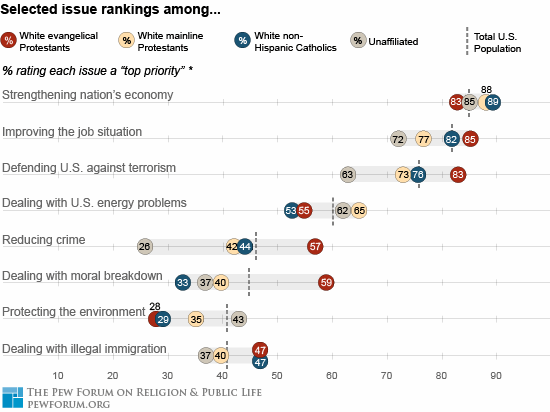
Theologically speaking, God can be found in all situations. In even the most heinous of events, we can trust God to be at least suffering with those who suffer, mourning with those who mourn and crying with those who cry. So even in this trying economic time, we can envision God’s concern for those who are worst hit by our unfolding system of commerce – the worst hit, of course, being the poorest of the poor and not particularly those whose fortune may have been trimmed by a few billion. Given this, I find interesting the results of a Pew Forum survey of religious people in which they were asked where President Obama and the legislature should concentrate their efforts. Additionally interesting, although I have yet to find an explanation, is the fact that the categories include only white religious people. We are left to surmise the purpose of that decision.

pew623

Continue reading ‘Religions Put Emphasis on Least Theological Issues’

20
Mar
09

Post-Exilic Community in Haggai & Zechariah 1-8

While there seems to be little disagreement over the dating of the prophesies of Haggai and Zechariah[1], the same cannot be said about conditions of the society to which they were delivered. To a large extent, the differences stem not so much from the content of these Biblical books as from varying ideas about the nature of the Babylonian exile of the Judeans. Knowledge of the number and societal standing of the exiles would, of course, have great bearing on the current understanding of both the returning exilic population and those remaining in Judah during the course of the seventy year dispersion. The details relating to the Judean society that can be gleaned from the pages of these prophetic books must be examined in light of the range of ideas that prevail about the previous period. Continue reading ‘Post-Exilic Community in Haggai & Zechariah 1-8’

12
Mar
09

Book Review – Between Vengeance and Forgiveness

How do nations or societies respond after periods of mass violence, indescribable episodes of systematic torture, rape and slaughter of minority or marginalized populations, or even ethnic cleansing and genocide?  Historically, of course, the most common response of populations freed from such oppression has been retaliation in at least equal measure, if not more profoundly violent and obscene in character. Despite the world, in the twentieth century, experiencing atrocities of more magnitude and frequency than ever before, Martha Minow somewhat optimistically details several societal responses aimed at seeking collective healing and reconciliation. After discussing the poles of vengeance and forgiveness, Minow expounds on the strengths and limitations of legal remedies, truth commissions and efforts at reparation, before finishing with other possible efforts for reconciliation. Continue reading ‘Book Review – Between Vengeance and Forgiveness’

08
Mar
09

Mission Prayer

This is a prayer to be said by those going to and coming from immersion mission trips. It is a reminder to hold sacred what others trust you with, especially their hearts. Continue reading ‘Mission Prayer’

08
Mar
09

Risking Transformation

Readings:  2 Kings 2:1-14     Mark 9:2-9

Here we have two passages about transformation. There are, obviously, links between the two. Both talk about Elijah, and each deals with a person being transformed by God in the presence of witnesses.  And it’s those witnesses I am most interested in.

Each of these principle characters had disciples. Jesus, of course, had several but only three were present – Peter, James and John. Elijah had one, Elisha. Both sets of disciples had just been told that their mentor – their master, if you will – was approaching the end of their ministries, and would soon be taken away. The reactions to these events are interestingly different, despite the similarities that exist. Continue reading ‘Risking Transformation’

04
Mar
09

Right (Re)Defining “Bashing”

“BASHING”a word that has long been used by minorities to describe the actions of mobs and people motivated by hate. Some on the religious-right, because of the attention on gay bashing, have started to appropriate this word to talk about how they are being discriminated against. This video is potentially troubling because of some fo the images, but is a must see for those who wish to understand how the word “bashing” in being co-opted and watered down. Continue reading ‘Right (Re)Defining “Bashing”’

28
Feb
09

No, Please! Tell Us What You Really Think

If you are looking for the perfect example from which to learn to write a “quirky, snide, and very thoughtless comment” to someone with whom you disagree – look no further. Sen Paul Koering’s aid seems to have the technique down to a fine science, and will gladly send you an example should you want to disagree with the senator on anything.

 News from the Minnesota Independent: Gay Republican responds to criticism: Same-sex marriage is a ‘pointless issue’

The office of state Sen. Paul Koering, a gay Republican representing a district near Brainerd, Minn., is responding by e-mail to criticisms over his decision not to vote for the Marriage and Family Protection Act. The gist? Legislators can’t “waste their time” with “pointless legislation.”

The mass e-mail, penned by an impassioned Ken Swecker, Koering’s legislative assistant, concludes with a punchline that shows someone’s got their knickers in a wad over something. Swecker wrote: Continue reading ‘No, Please! Tell Us What You Really Think’

25
Feb
09

Swimming Upstream – an Autobiography (Part 4)

Continued from LEARNING TO THRIVE. Or return to INDEX.

LEARNING TO SWIM – I was in the big pool now.

In the week prior to starting at seminary, I had moved into an apartment on campus – completely furnished and outfitted from the generosity of my Liberty Church supporters – and I had finished up a six-month, 10-hour per week consulting gig at Sterling Commerce, a division of the telecom giant, SBC. I had hated the thought of returning to the business world, but the opportunity had cropped up within hours of deciding to go back to school. Continue reading ‘Swimming Upstream – an Autobiography (Part 4)’

23
Feb
09

Swimming Upstream – an Autobiography (Part 2)

Continued from Part 1 – Learning to Learn. Or go to INDEX.

LEARNING TO LIVE

The first few years in Ohio were emotionally devastating for my mother. We lived in abject poverty even by our standards, my mother’s family proved to be more dysfunctional than our own, and work, except for the lowest paid positions, was tough for her to find. I began working before and after school to help out, lying about my age to avoid problems. I also found my missing childhood. My ‘toys’ were different than anyone had hoped, but they succeeded in dulling the pain. By sixteen I drank constantly, was addicted to speed, and had forced my mother to seek a community more conducive to a normal childhood. We moved to Newark, Ohio during my junior year. The school administrators were a little worried about my record, but seemed encouraged by my high grade point average. I graduated in possession of a full scholarship from OSU, twenty-five credits when seventeen were needed, damage from a heart attack I suffered during a speed overdose, and a new addiction to qualudes, which the doctor prescribed for “sleeping problems”. I also held the school record for drinking the most beers in a single sitting. Life was good. Continue reading ‘Swimming Upstream – an Autobiography (Part 2)’

20
Feb
09

Brooding on Beatitudes

Blessed are the poor in spirit, for theirs is the kingdom of heaven.

The meaning of the word “poor” in Greek means one who has nothing and is completely empty. Was Jesus saying the economically poor are blessed? No, for there is no inherent spirituality in poverty. Poverty in itself is not blessed, because the poor can be as arrogant and as ungodly and as lost as the wealthy and powerful. So what does it mean to be poor in spirit? It means that the poor are those who realize that they can never achieve salvation on their own and instead put their complete faith and trust in Jesus Christ.

The poor in spirit are those who are not self-assertive, self-reliant, self-confident, self-centered, self-righteous or self-sufficient. The poor in spirit are not baptized in the waters of self-aggrandizement. Continue reading ‘Brooding on Beatitudes’

20
Feb
09

ELCA Wrestles out its Conscience

The Presbyterian Church (USA) is not alone in its efforts to find a suitable middle ground in the debate over sexuality. There! That’s some surprising news, eh? The ELCA is on the verge of proffering its won solution to the internal squabbles over basic rights for an entire class of candidates for ministry and the populations they may represent. The “Proposed Social Statement on Human Sexuality” does essentially the same things as the PC(USA)’s G-6.0106b Amendment 08B – establishes local authority to discriminate or not. It is not an ideal solution, by a long stretch, but a awkward step forward. Continue reading ‘ELCA Wrestles out its Conscience’

17
Feb
09

I Just Can’t Resist

BBC News – Wierd Alien Life Forms “May Exist Among Us” http://news.bbc.co.uk/2/hi/science/nature/7893414.stm

This is news? I’ll let the article speak for itself – resist the urge to “pun” this into the ground, much the same a Leo Kottke does with a sweet melody. Oh, the one-liners that exist in this article alone. Do I have the self-control? Continue reading ‘I Just Can’t Resist’

16
Feb
09

The Baby in the Bath Water

In colonial America, as in other places where water was fetched and heated only with great effort, ablutions were a family process. One by one, beginning with the father, then the mother and continuing through the youngest child, all would bath in the same tub of water. Both parents, as well all the oldest kids, worked the fields and tended the livestock. Of course, children also played outside. Saturday, in order to be clean for Sunday church service, was the proverbial bath night.  The old German proverb, “Don’t throw the baby out with the bathwater” had a very real meaning for early American settlers. Admittedly, even though the water was so tepid and dirty by the time the youngest of perhaps a dozen or more children were finished bathing that it would have been easy, it would have been ridiculously rare, if it ever happened at all, to loose a child in the muck. Rather than literal, the saying came to represent a frontier dweller’s value for resources similar to that expressed in the adage, “one person’s trash is another person’s treasure.” Continue reading ‘The Baby in the Bath Water’


... or, preaching from both ends

WELL, HELLO! YOU’RE HERE.

That's too bad - I'm so sorry. Oh, well, just try to make the best of it. What you'll find here is a variety of essays and ramblings to do with things theological, social, whimsical and, sometimes, all three. I don't write to get famous - trust me, I've been told how futile that would be - but to express myself. I love to communicate and browbeat - ummm, I mean dialogue - about the things I find intriguing. Since you're here, and the door's locked, why don't you stay a while. There's a page bar under the header with links to information about us - I mean me. Don't forget to tell me what you think - in a nice way, I mean.

Readers since Jan 2009

  • 145,747 posts read

Archives